
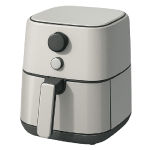
An air fryer making noise is one of the most common complaints owners report in 2026 — and while some causes are a 10-minute fix, others point to a failing motor that needs component-level diagnosis. This guide ranks the four most likely causes from simplest to most complex so you can resolve the problem without unnecessary disassembly.
4 Common Causes for Air Fryer Noise
1Loose or Misaligned Basket Assembly
The basket drawer and its rail system take mechanical stress every time the unit is opened and closed. Over time, the plastic rail tabs can crack, the handle fastener can loosen, or the basket can simply stop seating fully into the housing — any of which creates a persistent rattle or clunking sound during operation as the basket vibrates against the surrounding frame.
Symptoms
- Rattling or clunking sound that changes pitch when you gently press on the front of the drawer
- Noise stops or diminishes when you hold the basket handle lightly while the unit runs
- Visible cracks on the basket handle, side rails, or the tab that locks the drawer into position
Care Plan
- Unplug the unit and allow it to cool completely before handling.
- Remove the basket drawer fully and inspect the rail guides on both sides of the housing for cracks, warping, or broken locking tabs.
- Inspect the basket handle fastener — on most models, a single Phillips screw secures the handle to the basket frame. Tighten it if loose.
- Reinsert the basket and push firmly until you feel and hear the locking tab click into place. Run a short cook cycle and listen for the rattle.
- If the rail tabs are cracked or broken, order a replacement basket assembly for your model. Replacement baskets typically cost $15–$30 for budget and mid-range models; premium brand assemblies may cost more. If the noise persists after installing a new basket, move on to Cause 2.
Common Mistakes
- Reinserting the basket at a slight angle, which causes the rail to skip the guide channel and produce a worse rattle than before.
- Ordering a replacement basket by size alone rather than by model number — basket dimensions vary even within the same brand lineup, and an ill-fitting basket will rattle immediately.
2Food Debris Near the Fan Blades
In basket-style air fryers, the fan sits above the cooking chamber and draws hot air up and over the food. Small food particles — breadcrumbs, dried herb flakes, loose seasoning — can migrate upward during cooking (because the fan draws hot air up through the chamber) and lodge near or against the fan blades. Even a small fragment contacting a spinning blade at high RPM produces a persistent clicking or ticking sound that can be mistaken for a mechanical failure.
Symptoms
- Rapid, rhythmic clicking or ticking sound that begins shortly after the unit reaches cooking temperature
- Noise varies in intensity as the fan accelerates or decelerates between cook cycles
- Visible crumbs or debris on the heating coil guard when you inspect the cooking chamber
Care Plan
- Unplug the unit and allow it to cool for at least 30 minutes before proceeding.
- Remove the basket drawer and look up into the cooking chamber with a flashlight to inspect the fan blades and heating coil guard. Keep your hands outside the cavity during this inspection. Do not touch the heating coil — the wire element can have sharp edges even when cold.
- Using a soft-bristled toothbrush or small cleaning brush, gently dislodge any visible debris from the heating coil guard and the area around the fan blades. Work carefully and avoid bending the guard or the heating coil.
- Tilt the unit gently over a trash can to allow loosened debris to fall out of the chamber, then use a can of compressed air to blow out any remaining particles. Direct the airflow downward through the chamber opening.
- Reinstall the basket, run a short empty cook cycle at 350°F for 3 minutes, and listen for the clicking sound. If the noise persists with a clean chamber, proceed to Cause 3.
Common Mistakes
- Using a wet cloth or damp sponge inside the cooking chamber, which can deposit moisture near the heating element and fan motor housing.
- Using a vacuum with a hard plastic attachment directly against the fan blade guard, which can crack the guard or contact and bend the fan blades.
3Failing or Obstructed Fan Motor
The fan motor in a basket-style air fryer runs continuously during every cook cycle. When the motor’s bearings begin to wear — due to age, heat cycling, or fine debris entering the motor housing — it produces a grinding, whirring, or high-pitched squealing sound that worsens over time. A completely seized or failed motor stops the fan from circulating air, which causes the heating element to overheat. Modern air fryers include a thermal fuse that should cut power in this scenario, but relying on that safety device as a substitute for a functioning fan is not safe practice and can result in a damaged unit or, if the fuse fails, a fire risk.
Symptoms
- Persistent grinding, squealing, or high-pitched whirring that is clearly coming from inside the unit rather than the basket area
- Noise is present from the first second of operation and does not change based on basket position
- Cooking performance has declined noticeably — food takes longer to cook or cooks unevenly — suggesting reduced airflow
Care Plan
- With the unit fully cooled and unplugged, place it upside down on a clean, padded work surface. Locate the base panel — on most basket-style air fryers, it is secured by 4–6 Phillips screws around the perimeter.
- Before touching any internal components: inspect visually for any signs of burning — discoloration, melted plastic, or a burnt smell originating from the motor or surrounding wiring. If you observe any of these signs, stop immediately, close the housing, and take the unit to a certified repair technician. Do not proceed further. If the unit looks and smells clean, continue.
- Remove the base panel screws and lift the panel away. Photograph the wiring connections and harness routing with your phone before disconnecting anything. Most harness connectors are keyed — physically shaped so they will only fit in one orientation — but photographing them before removal eliminates any guesswork during reassembly.
- Locate the fan motor. Attempt to spin the fan blade by hand — it should rotate smoothly with minimal resistance. If it grinds, catches, or is completely stiff, the motor bearings have failed. Order a replacement fan motor compatible with your specific model number. Parts cost $15–$80 depending on brand — verify part availability and cost before committing to a repair over replacement, as premium brand OEM parts can be expensive or unavailable. Disconnect the motor harness connector and remove the mounting screws to extract the motor. Install the new motor in reverse order.
- If the motor spins freely by hand but the noise persists when powered, the issue may be a loose fan blade on the motor shaft (a common wear point). Check that the blade is firmly pressed onto the shaft with no wobble. If the motor and blade appear intact and the noise continues after reassembly, escalate to a small appliance repair technician — the issue may involve the control board driving the motor.
Common Mistakes
- Forcing a wiring harness connector into the wrong socket. While connectors are typically keyed, forcing them can damage the connector tabs and create an intermittent electrical fault. If a connector does not seat easily, verify orientation against your photograph.
- Purchasing a fan motor by voltage and physical size alone without confirming the model number compatibility. An incorrectly specified motor can run too fast or too slow for the unit’s thermal design.
4Loose Housing Panels or Internal Brackets
Over time, the vibration from the fan motor can gradually loosen the external housing screws and internal mounting brackets. A loose outer panel resonates with the motor’s frequency and produces a buzzing or low rattling sound that is difficult to localize. In some cases, the metal guard that surrounds the heating element can lose a mounting tab, causing it to vibrate against the element housing.
Symptoms
- Low, buzzing rattle that is felt as a slight vibration when you touch the outer housing panels
- Noise changes noticeably when you apply light hand pressure to different sides of the unit while it is running
- Sound is consistent and rhythmic — matching the fan motor’s operating frequency — rather than intermittent or food-related
Care Plan
- With the unit plugged in and running, briefly apply light pressure to each cool side panel only — avoid the top vent and rear exhaust, which expel hot air. Note whether the noise changes or stops when you press on a specific panel. Unplug the unit immediately after this test before doing anything else.
- Once unplugged and cooled for 30 minutes, inspect the outer housing screws on the base and rear of the unit. Tighten any that are loose with the appropriate Phillips screwdriver. Do not overtighten plastic-threaded housings — firm contact is sufficient.
- Remove the base panel (as described in Cause 3) and inspect the internal mounting brackets that secure the fan motor housing and control board. Tighten any loose screws by hand. Only apply threadlocker to screws on the outer housing or base panel if needed — do not apply threadlocker to any screws near the heating element or fan motor, where operating temperatures may exceed the compound’s rating. For outer housing screws that repeatedly loosen, a small dab of non-permanent threadlocker (such as Loctite Blue 242) is appropriate only in those cool exterior locations.
- Inspect the metal guard around the heating element for any loose mounting clips or missing screws. If the metal guard is rattling against the heating coil, gently reposition it (while cold) using needle-nose pliers to ensure there is a clear gap between the guard and the element.
- Final Reassembly: Ensure all internal wiring is tucked back into its original routing clips so that no wires are vibrating against the plastic housing or the fan motor. Reattach the base panel, tighten all exterior screws, and run a 2-minute test cycle.
Common Mistakes
- Applying liquid threadlocker near the heater. As noted, chemical threadlockers can outgas or fail at high temperatures. Only use these on the outermost “cool” screws of the base or rear panel.
- Overtightening screws into plastic. Air fryer housings are typically made of ABS or similar plastics that can strip easily. If you over-torque a screw, it will spin freely and the rattle will become permanent. Tighten only until you feel firm resistance.