
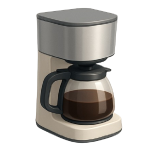
A coffee maker making weak coffee is one of the most common — and most fixable — appliance complaints in any kitchen. While the cause is often something as simple as a grind adjustment or a descaling cycle, in some cases it points to a failing heating component that requires more involved diagnosis. This guide ranks all five causes from most to least likely so you can work through them efficiently in 2026 without wasting time or money on the wrong fix.
5 Common Causes for a Coffee Maker Making Weak Coffee
1Mineral Scale Buildup
Mineral Scale Buildup Blocking Water Flow
Hard water deposits calcium and magnesium minerals inside your coffee maker over time, gradually coating the heating element, narrowing the water lines, and partially blocking the spray head. The result is slower water flow through the grounds and lower-temperature water at the brew head — both of which produce under-extracted, weak coffee. This is the single most common cause of a gradual decline in brew quality and is almost always the right place to start.
Symptoms
- Coffee has become progressively weaker over several weeks or months with no other changes
- The brew cycle takes noticeably longer than it used to
- You can see white or grey mineral crust around the spray head or carafe opening
Care Plan
- Empty the carafe and remove any paper filter and used grounds.
- Fill the water reservoir with a 50/50 mixture of white vinegar and fresh water, or use a commercial descaler (such as Durgol or Dezcal) mixed according to the product instructions.
- Run a full brew cycle with the descaling solution, then pause the machine halfway through and allow the solution to sit in the lines for 20–30 minutes to dissolve accumulated scale.
- Resume and complete the brew cycle, then discard the solution.
- Run two to three full brew cycles with plain fresh water to flush all vinegar or descaler residue before brewing coffee. If the coffee still tastes weak after descaling, move to Cause 2.
Common Mistakes
- Using a vinegar concentration higher than 50% — it does not descale faster and can leave a residual taste that takes many rinse cycles to clear.
- Skipping the mid-cycle soak and running the descaling solution straight through — the contact time is what dissolves the mineral deposits, not the flow alone.
2Wrong Grind Size or Coffee-to-Water Ratio
Wrong Grind Size or Coffee-to-Water Ratio
Using too little coffee, too coarse a grind, or water that hasn’t reached the proper brewing temperature (195°F–205°F) all result in under-extraction — the brewing process completes before enough flavor compounds dissolve into the water. This is one of the most overlooked causes because it develops gradually as habits drift or as a new bag of beans behaves differently from the last.
Symptoms
- Coffee tastes thin and watery even from a freshly cleaned machine
- The brewed coffee lacks aroma as well as flavor
- The issue appeared after switching to a new coffee brand, bag, or grind setting
Care Plan
- Check your coffee-to-water ratio: the standard guideline recommended by the Specialty Coffee Association is 1 to 2 tablespoons of ground coffee per 6 ounces of water. If you have been using less than that, increase incrementally and brew a test pot.
- Check your grind size. For a standard auto-drip coffee maker, the correct grind is a medium grind — it should look and feel similar to granulated table salt or coarse sugar. If the grind feels like fine powder (closer to an espresso grind), it is too fine and will clog the filter, slowing water flow and producing bitter rather than weak coffee. If it feels like rough sea salt or small pebbles, it is too coarse and will produce weak, under-extracted coffee because water passes through too quickly.
- If you use a burr grinder, adjust one step finer than your current setting and brew a test pot. If you use pre-ground coffee, confirm the bag is labeled for drip brewing — espresso-ground coffee is too fine, and French press or cold brew grinds are too coarse.
- Brew a fresh pot at the corrected ratio and grind setting and compare the result.
- If the coffee is still weak despite a correct ratio and medium grind, move to Cause 3.
Common Mistakes
- Targeting a coarse grind for auto-drip brewing — coarse grind is correct for French press and cold brew, not for standard drip machines, and will reliably produce weak coffee.
- Measuring coffee by volume using a heaped scoop rather than a level tablespoon — this introduces significant inconsistency in dose and makes it difficult to diagnose a ratio problem.
3Clogged Spray Head or Filter Basket
Clogged Spray Head or Filter Basket
The spray head (also called the shower head or dispersion disc) distributes hot water evenly over the coffee grounds. When it becomes clogged with mineral scale or coffee oil residue, water is channeled through only part of the grounds rather than saturating them evenly — a phenomenon called channeling — which causes significant under-extraction and weak flavor. The filter basket can develop similar issues if oils and fine grounds accumulate in the mesh.
Symptoms
- You can see water dripping unevenly from the spray head rather than spreading uniformly
- The coffee puck is wet and under-extracted on one side and dry on the other after brewing
- The machine was recently descaled but coffee is still weak
Care Plan
- Unplug the machine and allow it to cool completely before removing any components.
- Locate the spray head — on most drip coffee makers it is a circular disc or nozzle directly above the filter basket, typically removable by twisting counterclockwise or releasing a small clip.
- Remove the spray head and soak it in undiluted white vinegar for 20–30 minutes to dissolve mineral deposits. For light buildup, 10 minutes may be sufficient, but moderate-to-heavy deposits — common in hard-water households — require the longer soak time.
- Use a toothpick or soft-bristle brush to clear any remaining debris from the spray holes, then rinse thoroughly under running water.
- Remove the filter basket and wash it with warm soapy water or soak it in a 50/50 vinegar-water solution for 15 minutes. Rinse well, reassemble, and run a plain water brew cycle before making coffee. If uneven flow continues after cleaning, the spray head may need replacement (typically $2–$10 for most models); if coffee remains weak, move to Cause 4.
Common Mistakes
- Reinstalling the spray head without rinsing it thoroughly after a vinegar soak — residual vinegar will carry through into your next pot of coffee.
- Using a metal pick or wire to clear spray holes — this can enlarge the apertures and permanently alter water distribution.
4Failing Heating Element or Thermostat
Failing Heating Element or Thermostat
The heating element is responsible for bringing water to the correct brewing temperature of 195°F–205°F. When it begins to fail or when the thermostat that controls it drifts out of calibration, water may reach the grounds at a significantly lower temperature — producing pale, weak, under-extracted coffee. This is the least common cause of weak coffee but one of the more costly to address.
A practical field test: brew a full pot and immediately measure the water temperature in the carafe using a kitchen thermometer. Because coffee loses heat through the brew path, carafe walls, and ambient air during brewing, a properly functioning machine will typically read somewhere in the 175°F–185°F range in the carafe. A reading below 170°F is a reliable indicator that the water was likely not reaching proper brewing temperature at the brew head. Note that this is an imprecise proxy — the carafe reading cannot tell you the exact temperature at the brew head — but a significantly low result (below 170°F) is a meaningful flag worth investigating further.
Symptoms
- Brewed coffee in the carafe reads consistently below 170°F immediately after brewing
- The brew cycle completes, but the coffee is pale in color and thin in flavor despite correct ratio and grind
- The machine is five or more years old and has never had electrical components serviced
Care Plan
- Unplug the coffee maker and allow it to cool and sit unplugged for at least 5 minutes.
- Remove the bottom panel — most models use Phillips head screws — to access the heating element and thermostat assembly. Photograph the interior before touching anything so you have a reference for reassembly.
- Locate the thermostat (a small disc or cylindrical component attached to the heating element or boiler tube). Use a multimeter set to resistance (ohms) to test continuity across the thermostat terminals. An OL (open loop) reading indicates the thermostat has failed open and needs replacement. Important: A passing continuity reading does not fully rule out a faulty thermostat — a thermostat can drift out of calibration and open too early while still showing normal continuity. If your thermostat passes this test but symptoms persist, professional diagnosis is the appropriate next step.
- If you need to replace the heating element: on many budget and mid-range drip coffee makers, the heating element is not a standalone user-replaceable part — it is often bonded to the boiler assembly or permanently fastened to the chassis. Before ordering any parts, confirm that a standalone replacement element is available for your specific make and model. Where standalone parts are sold, they typically cost $15–$60, though parts availability varies significantly by brand. If no standalone part exists for your machine, the realistic options are full boiler sub-assembly replacement or professional repair assessment.
- If internal inspection is beyond your comfort level, or if your machine is a premium model, take the unit to a qualified small appliance repair technician. A professional diagnostic and repair for a heating element typically costs $75–$200 (parts and labor). If the unit is a budget model costing under $50, the repair cost will exceed the value of the machine, and recycling the unit is the more practical choice.
Common Mistakes
- Measuring temperature too late. If you wait five minutes after the brew cycle to check the carafe temperature, you will get a falsely low reading. You must measure the moment the last drop hits the carafe for an accurate assessment of the heating element’s performance.
- Assuming the warming plate is the heater. Drip machines have one main heating element that does two jobs: it boils the water for brewing and keeps the plate hot. If your plate is hot but the coffee is weak, the element is likely working, but mineral scale (Cause 1) is preventing the water from staying in the heater long enough to reach 200°F.
5Stale or Improperly Stored Coffee Beans
Stale or Improperly Stored Coffee Beans
Even with a perfectly functioning machine, your coffee will taste weak if the beans themselves have lost their soluble compounds. Once roasted, coffee beans begin to oxidize. Within 3–4 weeks, most of the volatile oils and aromatics have dissipated. When you brew stale beans, the water cannot extract the complex flavors required for a “strong” cup, leaving you with a brew that tastes thin, woody, or paper-like.
Symptoms
- The coffee has no “bloom” (bubbles) when water first hits the grounds.
- The coffee has a flat, dull aroma even while brewing.
- You are using beans that have been sitting in a clear container, in the freezer, or in an open bag for more than a month.
Care Plan
- Check the Roast Date: Look for a “Roasted On” date rather than a “Best By” date. For the best results in a drip machine, use beans roasted within the last 14–21 days.
- Buy Whole Bean: Ground coffee has significantly more surface area exposed to oxygen and goes stale in days, not weeks. Switching to whole beans and grinding them just before brewing is the single most effective way to fix “weak” flavor.
- Store Properly: Keep your beans in an airtight, opaque container at room temperature. Avoid the freezer; moisture from the freezing/thawing process can damage the cell structure of the bean and lead to a weak, “off” flavor.
- Clean your Storage: If you use a reusable container, wash it every time you switch bags. Old coffee oils turn rancid and can make even fresh beans taste weak and sour.
Common Mistakes
- Storing coffee in the fridge or freezer. This introduces moisture and causes the beans to absorb food odors, both of which degrade the flavor and make the resulting brew taste weak and chemically.
- Buying in bulk without a plan. Unless you can finish a large bag within three weeks, buying smaller quantities more frequently will ensure your coffee maker always produces a robust cup.