
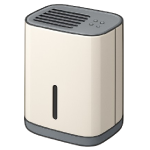
A dehumidifier not collecting water is one of the most common appliance complaints homeowners face, especially heading into the humid months of 2026. Some causes — like a dirty filter — take five minutes to fix for free, while others signal a component failure. This guide ranks the five most likely causes from easiest to hardest so you can diagnose the real problem efficiently.
5 Common Causes for a Dehumidifier Not Collecting Water
1Dirty or Clogged Air Filter
The air filter on a dehumidifier prevents dust and debris from coating the evaporator coils. When this filter becomes clogged, airflow through the unit drops dramatically — and without sufficient air moving across the coils, the unit cannot pull moisture from the room no matter how long it runs. This is the single most common reason homeowners find an empty bucket, and it costs nothing to fix if the filter is washable — or as little as $5–$20 if a replacement is needed.
Symptoms
- The unit runs continuously but the collection bucket stays empty or nearly empty
- Visible gray or white dust buildup on the filter mesh when you slide it out
- The unit feels warm on the exhaust side but barely moves air
Care Plan
- Unplug the dehumidifier from the wall outlet before doing anything else.
- Locate and remove the air filter — on most models it slides out from the front or back grille. Consult your owner’s manual if the location is not immediately obvious.
- Hold the filter up to a light source. If it is gray, matted, or you cannot see light through it clearly, it needs cleaning or replacement.
- If the filter is a washable mesh or foam type (the most common design), rinse it under warm running water, gently scrub with a soft brush, and allow it to air-dry completely before reinstalling — never reinstall a wet filter.
- If the filter is a non-washable disposable type, replace it with a manufacturer-specified (OEM) replacement filter that matches your model number ($5–$20 at hardware stores or the manufacturer’s website). Note: Not all dehumidifiers use replaceable disposable filters — many use only a permanent washable mesh. Consult your owner’s manual to confirm your filter type before purchasing a replacement, as generic filters may not be available for your unit.
Common Mistakes
- Reinstalling the filter while it is still damp — a wet filter restricts airflow just as badly as a dirty one and can promote mold growth on the coils.
- Skipping filter maintenance for an entire season and expecting a single cleaning to immediately restore full performance — if the coils are already coated with dust that bypassed a long-neglected filter, the coils themselves will need cleaning as a follow-up step.
2Room Temperature Too Low
Standard compressor-based dehumidifiers operate on the same refrigeration cycle as an air conditioner — they chill a set of evaporator coils to condense water vapor out of the air. When ambient room temperature falls below the unit’s rated minimum operating temperature, this condensation process slows dramatically and eventually stops altogether, leaving the bucket dry even while the unit runs. This is especially common in basements and garages during cooler months.
Symptoms
- The unit runs normally — fan spinning, compressor cycling — but no water appears in the bucket
- The room feels genuinely cool or cold to the touch (below approximately 60–65°F, though the exact threshold varies by model)
- The unit may display a “low temperature” indicator light if your model includes one
Care Plan
- Unplug the unit and locate your owner’s manual (or look up your model number online) to find the manufacturer’s stated minimum operating temperature — this varies significantly between models, so do not assume a universal cutoff applies to your unit.
- Use a standalone thermometer or a digital hygrometer ($10–$15 at hardware stores) to check the actual temperature in the room where the dehumidifier is running.
- If the room temperature is at or below your model’s minimum, the unit is functioning as designed — it simply cannot operate efficiently in those conditions.
- If possible, move the dehumidifier to a warmer interior space, or use a small space heater to bring the room temperature above the unit’s minimum operating threshold before running the dehumidifier.
- If the space is consistently cold and cannot be practically heated — such as a crawl space or uninsulated garage — consider replacing the unit with a desiccant dehumidifier, which uses a moisture-absorbing wheel rather than refrigeration coils and is rated for operation down to near-freezing temperatures.
Common Mistakes
- Assuming 65°F is a universal hard cutoff for all dehumidifiers — some compressor models are rated down to 41°F while others do stop at 65°F. Always verify against your specific model’s documentation before relocating the unit or purchasing a replacement.
- Running the unit continuously in temperatures below its rated minimum in hopes it will eventually start collecting water — prolonged operation below the minimum threshold stresses the compressor and can accelerate wear.
3Frozen Evaporator Coils
If airflow is restricted (often due to a dirty filter) or the room temperature is borderline low, the evaporator coils can ice over completely. A solid block of ice on the coils prevents any new condensation from forming and draining into the bucket, and the unit effectively becomes a refrigerated box that produces no water. You may actually see ice visible through the front grille, or notice water puddling on the floor from melting ice rather than draining into the bucket properly.
Symptoms
- Visible frost or ice on the coils, visible through the front grille
- Water leaking onto the floor around the base of the unit rather than collecting in the bucket
- The unit runs but produces no water, and the exhaust air feels unusually cold rather than slightly warm
Care Plan
- Unplug the unit immediately — running a dehumidifier with frozen coils strains the compressor and will not fix itself while the unit is operating.
- Remove the water collection bucket and empty it fully. Place old towels around the base of the unit to absorb meltwater.
- Allow the coils to thaw at room temperature. To speed the process, point a separate standalone fan at the coils through the front grille — do not use a heat gun or hair dryer directly on the coils, as direct heat can damage the aluminum fins or plastic housing.
- Once fully thawed (typically 1–3 hours depending on ice buildup), inspect and clean the air filter following the steps in Cause 1 above, since a dirty filter is usually the root cause of coil freezing.
- Plug the unit back in, reinstall the bucket, and run the unit for two hours — monitor the coils visually through the closed front grille only. Do not open or remove the grille while the unit is operating. If the coils freeze again within a few hours, the root cause (restricted airflow, low ambient temperature, or a refrigerant issue) has not been resolved — escalate to a qualified appliance repair technician at this point.
Common Mistakes
- Plugging the unit back in before the coils are completely thawed — running the unit with even partial ice on the coils will re-freeze the remaining ice faster than it melts.
- Removing the grille to get a closer look at the coils while the unit is running — always monitor through the closed grille only when the unit is under power.
4Faulty Float Switch or Bucket Sensor
Most dehumidifiers include a float switch or electronic bucket sensor that automatically shuts the unit off when the collection bucket is full — preventing overflow. When this switch fails in the “full” position (the most common failure mode), the unit believes the bucket is always full and will not run its collection cycle, even when the bucket is completely empty. This can happen due to a stuck float arm, a corroded sensor contact, or a failed switch assembly.
Symptoms
- The unit powers on but shuts off almost immediately, even with an empty bucket
- The “bucket full” indicator light is illuminated even though the bucket is empty and correctly seated
- Removing the bucket entirely causes the unit to behave differently (on some models, removing the bucket triggers the same shutoff — consult your manual)
Care Plan
- Unplug the unit from the wall outlet and wait at least 30 minutes before reaching into any internal component area. Dehumidifiers contain capacitors that can retain an electrical charge even after unplugging — this waiting period allows them to discharge safely.
- Remove the collection bucket fully and locate the float switch assembly, typically a small plastic arm or rod inside the bucket bay near the top of the bucket slot. On models with an electronic sensor, you will see a small probe or contact in the same area.
- For a mechanical float arm: gently move the arm up and down by hand. It should move freely up and down under light pressure — if it feels sticky, gummed up, or refuses to move, clean the pivot point with a damp cloth and a small amount of white vinegar to dissolve mineral deposits.
- Inspect the sensor contacts or switch terminals for visible corrosion (white or greenish buildup). Clean contacts gently with a dry cotton swab or fine-grit sandpaper.
- If cleaning does not resolve the issue, order a replacement float switch assembly using your model number from the manufacturer or a parts supplier such as AppliancePartsPros or RepairClinic ($10–$40). Important safety note: Before replacing any internal electrical component, confirm the unit has been unplugged for at least 30 minutes to allow capacitors to discharge. Appliance wiring harnesses sit adjacent to capacitors that can retain a dangerous charge. Always unplug the unit and observe this waiting period — this is a safety requirement, not a personal preference. If you are unsure how to safely identify or work around internal components, hire a qualified appliance repair technician rather than proceeding with a DIY electrical repair. If you are confident, install the new switch, reconnect the wiring harness, and reseat the bucket. Plug the unit back in and verify that the “bucket full” light stays off until the bucket is actually filled.
Common Mistakes
- Failing to wait for the capacitor to discharge. This is the most dangerous mistake a DIYer can make with a dehumidifier. Touching the terminals of a charged capacitor can cause a severe electrical shock, even when the unit is unplugged. Always observe the 30-minute waiting period.
- Bending the float arm out of shape. If you use too much force while cleaning or testing a mechanical float, you can bend the arm, causing it to trigger the “full” sensor prematurely even if the switch itself is functional.
5Refrigerant Leak or Compressor Failure
The compressor and the refrigerant inside the coils are the “engine” of the dehumidifier. If the compressor fails to turn on, or if the sealed copper lines develop a pinhole leak and the refrigerant escapes, the coils will never get cold enough to condense water. This is the most serious and expensive failure possible. In most cases for residential portable units, this is a terminal issue where replacement is more cost-effective than repair.
Symptoms
- The fan runs, but you don’t hear the distinct “hum” or vibration of the compressor kicking on.
- The unit has been cleaned and the room is 70°F+, but the coils never feel cold to the touch.
- You notice oily residue or “stains” on the copper tubing near the coils (refrigerant contains oil that leaks out with the gas).
- The unit is less than 5 years old but has completely stopped collecting water regardless of the humidity level.
Care Plan
- Rule out all other causes first. Ensure the filter is clean, the room is warm, and the humidity setting on the control panel is set to “Continuous” or at least 10% lower than the actual room humidity.
- The “Warm Coil” Test. Let the unit run for 15 minutes. Carefully touch the evaporator coils (the ones behind the filter). If they are at room temperature or only slightly cool, the refrigeration system has failed.
- Check for “Sealed System” Warranty. Many 2026 manufacturers offer a limited 5-year warranty specifically on the compressor and coils, even if the general warranty is only 1 year. Locate your serial number and call the manufacturer; you may be eligible for a free replacement unit.
- Professional Diagnosis (Required by Law). If the unit is out of warranty, an EPA 608-certified technician must handle any refrigerant work. In 2026, a compressor replacement or leak repair typically costs $300–$600.
- Decide to Replace. Unless you have a high-capacity industrial or crawl space unit costing over $1,000, a compressor failure is usually the point where you should recycle the old unit and purchase a new Energy Star–rated model.
Common Mistakes
- Buying “refrigerant recharge” kits. You cannot “recharge” a dehumidifier like a car’s AC. These are sealed systems without service ports. Piercing the lines yourself is illegal under EPA regulations and will permanently ruin the unit.
- Running a unit with a dead compressor. If you hear the compressor struggling to start (a loud click followed by a hum that cuts out), turn the unit off. Forcing a failing compressor to run can cause electrical overheating.