
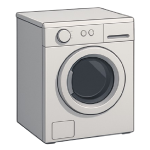
A dryer that keeps shutting off mid-cycle is one of the more disruptive appliance problems a homeowner can face, and the root cause ranges from a simple five-minute vent cleaning to a component replacement that takes under an hour. This guide ranks the four most common causes from most to least likely so you can work through them efficiently and get back to dry laundry as quickly as possible.
4 Common Causes for a Dryer That Keeps Shutting Off
1Clogged Dryer Vent
The dryer vent duct carries hot, moist air from the drum to the outside of your home. When lint accumulates inside this duct — in the flexible hose behind the unit, in the rigid metal duct inside the wall, or at the exterior cap — airflow becomes restricted and heat builds up inside the machine. Most dryers respond to this overheating by shutting off via a thermal cutoff device as a fire-prevention measure. Clogged dryer vents are one of the leading causes of home fires — thorough cleaning of the full duct run, not just the visible flexible hose, is essential for safety, not just appliance performance.
Symptoms
- Dryer shuts off after 10–20 minutes, then restarts normally once it has cooled down for several minutes
- Clothes feel hotter than usual at the end of a cycle, or the exterior of the machine is noticeably warm to the touch
- The exterior vent cap shows little or no airflow when the dryer is running
Care Plan
- Unplug the dryer (and close the gas supply valve if applicable). Pull the unit away from the wall to access the flexible hose at the back.
- Disconnect the flexible hose from both the dryer outlet and the wall duct collar. Inspect the hose for visible lint buildup, crushed sections, or kinks. Replace any damaged hose — use rigid or semi-rigid metal duct, not the plastic accordion style.
- Use a rotary brush kit (the correct tool for this job — $10–$25 at hardware stores) to clean the interior of the flexible hose and the wall duct from the dryer end. Push the brush through in sections, rotating continuously, and extract loosened lint with each pass. Leaf blowers are not recommended for interior duct cleaning — blowing air inward can compact lint at 90-degree bends or at the exterior cap rather than clearing it. If you choose to use a blower, direct airflow from the exterior cap outward, never inward.
- Go outside and clean the exterior vent cap. Remove the cap cover and clear any lint, debris, or bird nesting material by hand or with the brush kit. Confirm the damper flap opens freely.
- Reconnect the hose, push the dryer back into position, restore power, and run a full timed cycle while monitoring airflow at the exterior cap. If strong, consistent airflow is restored and the dryer completes the cycle without shutting off, the vent was the cause. If the in-wall rigid duct run is longer than approximately 10–15 feet, has multiple 90-degree bends, or cannot be fully reached from either end with your brush kit, hire a professional dryer vent cleaning service — attempting to clear a long or complex duct run without the right equipment often pushes lint deeper rather than removing it.
Common Mistakes
- Cleaning only the visible flexible hose while ignoring the rigid metal duct inside the wall — the in-wall section typically holds the heaviest lint accumulation in older duct runs and must also be brushed clear.
- Using a leaf blower to clear the vent from the dryer end — this can compact lint tighter into bends inside the wall rather than removing it. A rotary brush kit is the correct tool for interior duct cleaning in all cases.
2Blown Thermal Fuse
The thermal fuse is a one-time safety device that permanently cuts power to the heating circuit when the dryer reaches a dangerously high temperature. Unlike a thermostat, it does not reset — once it blows, it must be replaced. On most dryers it is a small oblong white or silver component with two wire terminals, typically mounted on the exhaust duct or heating element housing depending on your model. Consult your service manual or the manufacturer’s parts diagram to locate it precisely on your machine before beginning.
Symptoms
- Dryer turns on, tumbles, but produces no heat at all — clothes come out damp after a full timed cycle
- The dryer starts normally but shuts off quickly and will not restart until it has cooled, then repeats the same no-heat pattern
Care Plan
- Unplug the dryer from the wall outlet. If the outlet is hard to reach, trip the 240V breaker at the panel. Gas dryer owners: also close the gas supply valve before proceeding.
- Remove the back panel (most models) or the front panel and drum assembly (some brands) to access the exhaust duct area or heating element housing. Refer to your service manual for your specific model’s disassembly path.
- Locate the thermal fuse — a small oblong component with two wire terminals mounted on the exhaust duct or heating element housing, depending on your model. Disconnect the two wires.
- Set a multimeter to continuity mode and touch one probe to each terminal. A working fuse reads continuity (a beep or a reading near zero ohms). No continuity confirms the fuse is blown and must be replaced.
- Install the correct replacement fuse for your model number ($5–$20 at appliance parts retailers). Reconnect the wires, reassemble the panel, restore power, and run a test cycle. Important: if the new fuse blows again quickly, the root cause is still a blocked vent or a faulty heating element — address the vent blockage first, or the replacement fuse will blow again. Escalate to a professional if the fuse blows a second time after a confirmed clean vent.
Common Mistakes
- Bypassing the thermal fuse with a jumper wire to test the dryer — this eliminates the fire-prevention safety mechanism entirely and is a serious fire hazard. Replace it; never bypass it.
- Replacing the fuse without cleaning the vent first — the new fuse will blow again within a few cycles if the underlying overheating cause is not resolved.
3Faulty Door Switch
The door switch signals the dryer’s control board that the door is securely closed and it is safe to run. On most platforms this is a normally-open switch — the circuit closes when the door is shut, completing the run signal. When the switch fails or its plastic actuator tab breaks, the dryer interprets the door as open mid-cycle and shuts off immediately as a safety measure. Door switch failures are common after several years of use because the actuator is stressed thousands of times over the dryer’s life.
Symptoms
- Dryer shuts off suddenly mid-cycle and the display resets to the start of a cycle or shows a door-open indicator, even though the door is physically closed
- The dryer will not start at all unless the door is held firmly shut or the door is slammed rather than closed normally
Care Plan
- Unplug the dryer from the wall outlet and, if the gas supply applies, close the valve. If the outlet is inaccessible, trip the 240V breaker.
- Open the dryer door and locate the door switch — it is typically mounted inside the door frame on the front panel, activated by a plastic tab or pin on the door itself. Inspect the actuator tab for cracks or breakage.
- Remove the front panel or top panel as required by your model to access the switch wiring. Disconnect the wire harness connector.
- Set your multimeter to continuity mode. Test the switch with the actuator plunger depressed (simulating the door-closed position) — you should get continuity. Test again with the plunger released (door-open position) — you should get no continuity. Note: this test applies to normally-open door switches, which are the most common type. Verify your switch type in your service manual before interpreting results — some older or specialty models use a normally-closed configuration, which would produce opposite readings.
- If the switch fails either test, replace it with the correct part for your model ($10–$35). Reassemble, restore power, and run a complete cycle to confirm the fix. If the dryer still shuts off mid-cycle after a confirmed good switch, proceed to Cause 4.
Common Mistakes
- Testing the switch with the plunger in the wrong position and misreading a good switch as failed — always confirm which position corresponds to door-open and door-closed before condemning the part.
- Reassembling the front panel before testing the switch’s mechanical fit—ensure the door strike physically reaches and fully depresses the new switch’s plunger before tightening all cabinet screws.
4Failed Cycling Thermostat
The cycling thermostat is the component responsible for turning the heating element (or gas burner) on and off to maintain the temperature you selected on the control panel. It is typically mounted on the blower housing or the internal exhaust duct. If the thermostat fails, it may “trip” too early or fail to close the circuit again once the dryer cools slightly, causing the machine to shut down mid-cycle to prevent what it perceives as a dangerous overheat.
Symptoms
- The dryer runs for a few minutes, the air gets very hot, and then the unit shuts off completely.
- The dryer will not restart until it has sat for 30–60 minutes (the time it takes for the bi-metal strip inside the thermostat to reset).
- You notice the dryer is getting much hotter than the “Low Heat” or “Delicate” setting should allow.
Care Plan
- Unplug the dryer and turn off the gas (if applicable).
- Locate the thermostat: It is usually a small circular or oval disc with two to four wires, found on the blower housing or the exhaust ducting inside the cabinet.
- Test for continuity: Use a multimeter set to the lowest Ohm (Ω) setting. Disconnect the wires (photograph them first!). At room temperature, a functional cycling thermostat should show continuity (a reading near 0.00). If it reads “OL” or infinite, it has failed in the open position.
- Professional Calibration Test: Unlike a fuse, a thermostat can be “out of calibration” (tripping at the wrong temperature) even if it passes a continuity test. If you have cleaned the vents and replaced the fuse but the dryer still shuts off, replace this thermostat ($15–$50).
- Install the replacement: Ensure the mounting surface is clean of lint so the new thermostat can accurately “sense” the duct temperature. Reconnect wires, reassemble, and test.
Common Mistakes
- Mixing up the Thermostats: Most dryers have a cycling thermostat and a high-limit thermostat. The high-limit is a safety backup; the cycling one does the daily work. Replacing the high-limit won’t fix a cycling issue.
- Forgetting to check the “Heater” terminals: Some thermostats have four wires; the two smaller ones are for an internal heater used for lower-heat cycles. Ensure every wire goes back to its exact original terminal.




