
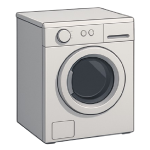
A dryer not drying clothes completely is one of the most common laundry complaints in 2026 — and fortunately, most causes are diagnosable and fixable without a service call. Some fixes take under 30 minutes; others require a multimeter and basic disassembly. This guide ranks the five most likely causes from easiest to hardest so you can work through them efficiently.
5 Common Causes for a Dryer Not Drying
1Clogged Dryer Vent
The dryer vent is the single most overlooked maintenance item on any dryer. Lint bypasses the lint screen on every load and gradually coats the inside of the exhaust duct. Once airflow is restricted, heat and moisture cannot escape, drying times double, and the dryer’s thermal fuse can blow as an overheat-protection response. A completely blocked vent is also a documented residential fire hazard.
Symptoms
- Clothes are damp or still warm at the end of a full cycle, with no improvement over multiple loads
- The exterior vent cap flap barely moves or does not open during operation
- The dryer drum feels excessively hot to the touch, or the laundry room smells musty or faintly of something burning
Care Plan
- Pull the dryer away from the wall carefully — if you own a gas dryer, check the gas flex connector for kinks or loose fittings as you move the unit. If you smell gas at any point, stop, leave the room, and call your gas utility’s emergency line before continuing.
- Disconnect the exhaust duct from the dryer’s exhaust port. Inspect the first 12 inches of duct for a visible lint blockage — remove any packed lint by hand.
- Use a dryer vent brush kit (a flexible rod system with a lint brush head, available for $10–$40) to clean the full duct run from the dryer end to the exterior wall cap. Work the brush through in sections, rotating it as you advance. Have a helper check that lint is exiting at the exterior cap.
- Go outside and remove the exterior wall cap cover. Clean out any lint, debris, or bird nesting material from the cap and verify the flap opens freely. Reconnect the duct using a clamp or foil tape — do not use plastic tape, which degrades from heat.
- Inspect every section of duct during reassembly. Replace any flexible plastic accordion hose with rigid or semi-rigid metal duct — rigid metal duct is the correct specification for most runs, while semi-rigid aluminum flex duct (not plastic) is acceptable for the last few feet of the connection between the dryer and the wall. Plastic accordion duct is explicitly prohibited by the IRC (International Residential Code) and most dryer manufacturers because lint collects at every ridge and creates a fire hazard. Note that even foil accordion duct is not recommended by most manufacturers for long or multi-bend runs — use rigid metal wherever possible. Run a timed dry cycle for at least 20 minutes with a damp load and confirm the exterior cap flap is opening fully and clothes are drying normally.
Common Mistakes
- Using flexible plastic accordion duct as a replacement — this is a fire hazard and code violation; use rigid or semi-rigid metal duct instead.
- Cleaning only the accessible section near the dryer and assuming the rest is clear — lint blockages most commonly occur at bends in the middle of the run or at the exterior cap, not at the dryer end.
2Failed Heating Element
The heating element is a coiled resistance wire inside a metal housing that generates the heat inside the drum. Over time — typically after years of heavy use — the coil develops a break, cutting off heat entirely. The dryer will continue to tumble and run its timer normally; it simply produces no warmth. This is the second most common cause of a dryer not drying after a clogged vent.
Symptoms
- Drum tumbles and the cycle runs to completion, but clothes come out completely cold and wet
- No warm air is felt at the exhaust vent during operation
- A multimeter test of the element shows OL (Over Limit — meaning the circuit is open/broken, indicating no continuity) or infinite resistance
Care Plan
- Unplug the dryer and turn off the 240V breaker at the panel before touching any internal components (see safety note above).
- Locate and remove the access panel for your specific model. Do not force any panel. On most Whirlpool and Maytag models the heating element is accessed from the rear panel. On many Samsung and some GE front-load models it is also accessed from the rear. On some LG front-load models, access requires removing the front panel and drum assembly first. Look up your model number on the manufacturer’s website or download the service manual to confirm the correct disassembly path before removing any fasteners — forcing the wrong panel can damage wiring harnesses or door seals.
- Before replacing the element, test all three components in the same disassembly session — the heating element, the thermal fuse, and the cycling thermostat — with a multimeter set to continuity or resistance. This prevents the common and costly mistake of replacing the element only to find another component was also failed. Set your multimeter to the continuity or resistance (ohms) setting. Touch one probe to each terminal on the heating element. A reading of OL (Over Limit) on the display — meaning the circuit is completely open — or infinite resistance confirms the element coil is broken and needs replacement. A functional element will show a low resistance reading, typically between 8–50 ohms depending on the model.
- Order a replacement element using your dryer’s full model number to ensure an exact match. Using an aftermarket part ordered by brand name alone — rather than by model number — often results in receiving an incompatible part with the wrong wattage rating. A mismatched wattage can cause underheating, overheating, or repeated thermal fuse failure.
- Install the new element, reconnect all wiring connectors to their original positions, reassemble the cabinet, restore power, and run a timed dry cycle for at least 20 minutes with a damp load to confirm heat is restored. If the dryer still produces no heat after element replacement, and you have already tested and confirmed the thermal fuse and cycling thermostat are also functioning correctly (Step 3), the problem likely lies with the control board — at that point, call a licensed appliance technician rather than continuing to replace parts speculatively.
Common Mistakes
- Replacing only the heating element without testing the thermal fuse and cycling thermostat in the same session — if a secondary component is also failed, the dryer will still not heat after the repair, resulting in wasted time and a second disassembly.
- Ordering a replacement part by brand name alone rather than by the dryer’s full model number, which often results in an incompatible part with the wrong wattage rating (a mismatched wattage can cause underheating, overheating, or repeated thermal fuse failure).
3Blown Thermal Fuse
The thermal fuse is a one-time safety device wired in series with the heating circuit. If the dryer overheats — most commonly because of a clogged vent — the fuse blows permanently and cuts power to the heater to prevent a fire. Unlike a circuit breaker, a thermal fuse does not reset; once blown, it must be physically replaced. Critically, replacing the fuse without also cleaning the vent that caused it to blow will result in the new fuse blowing again within a short time.
Symptoms
- The dryer runs, tumbles, and advances through the timer, but produces absolutely no heat
- This symptom appeared suddenly — the dryer was drying normally and then stopped heating entirely after one cycle
- A multimeter continuity test shows the fuse is open (no continuity)
Care Plan
- Unplug the dryer and switch off its dedicated breaker — the thermal fuse is wired directly to the high-voltage heating circuit.
- Access the thermal fuse by removing the back panel on most brands. On some models — including certain Whirlpool and Samsung units — you may instead need to remove the lower front access panel below the door opening. The lower front panel is a kick-plate-style access panel separate from the main door assembly, not the door itself. Consult your model’s service manual to confirm which panel provides access before removing fasteners.
- Locate the thermal fuse on the exhaust duct housing inside the cabinet — it is a small cylindrical or rectangular component with two wire leads attached. Disconnect the two wires.
- Set your multimeter to continuity mode and touch one probe to each terminal on the fuse. A functional fuse will beep or show near-zero resistance, confirming the circuit is intact. No beep and an OL (Over Limit — open circuit) reading confirms the fuse has blown and must be replaced. Note the temperature rating printed on the fuse’s housing and order an exact-match replacement using that rating and your full dryer model number — common residential dryer thermal fuse ratings include approximately 309°F (154°C), 250°F (121°C), and 228°F (109°C). Do not accept a substitute with a different temperature rating, as an incorrect fuse can either fail prematurely during normal operation or fail to protect the dryer from genuine overheating.
- Install the new fuse, reconnect the wires, reassemble the cabinet, restore power, and run a timed dry cycle for at least 20 minutes with a damp load and confirm the drum interior is producing heat. Before declaring the repair complete, perform Cause 1’s vent-cleaning procedure if you have not already done so — failing to clear the vent that caused the fuse to blow will result in the new fuse blowing again during your first full load. If the dryer still produces no heat after confirmed fuse and vent maintenance, proceed to Cause 5.
Common Mistakes
- Jumping the fuse to “test” the heater. Never bridge the thermal fuse terminals with a wire to see if the heater comes on. This bypasses a critical fire-safety device and can lead to a house fire if the dryer genuinely overheats.
- Ignoring the vent cleaning. A thermal fuse is a symptom of overheating, not a part that typically fails on its own. Always clean the exhaust duct when replacing this fuse.
4Dirty or Failed Moisture Sensor
Most modern dryers use two small metal strips inside the drum, usually near the lint filter, to detect how much moisture is left in the clothes. As wet clothes tumble against these strips, they complete a low-voltage circuit. If these sensors are coated in a waxy film from dryer sheets or fabric softeners, they can falsely report that the clothes are dry, causing the dryer to shut off prematurely.
Symptoms
- The dryer heats normally but shuts off while the clothes are still damp when using “Sensor Dry” cycles.
- The dryer works perfectly on “Timed Dry” but fails on “Auto” cycles.
Care Plan
- Locate the Sensors: Open the dryer door and look for two thin, silver metal bars (roughly 2–3 inches long) mounted on the interior bulkhead near the lint screen.
- Clean the Strips: Use a cotton swab or cloth dipped in rubbing alcohol (isopropyl) to vigorously scrub the surface of the metal bars. This removes the invisible waxy buildup from dryer sheets.
- Test for Continuity: (If cleaning fails) Unplug the dryer and access the sensor wires from behind the front or lower panel. Use a multimeter to ensure the wires haven’t vibrated loose.
- Replace if Corroded: If the metal strips are physically pitted or corroded, they may need to be replaced ($15–$60).
Common Mistakes
- Using a metal scraper to clean sensors. This can scratch the surface and cause lint to snag on the bars. Stick to rubbing alcohol and a soft cloth.
- Assuming the control board is dead. If the dryer stops too soon, people often blame the expensive brain of the machine when it’s just a 5-minute cleaning job on the sensors.
5Faulty Cycling Thermostat
The cycling thermostat is the switch that tells the heating element to turn on and off during a cycle to maintain a safe temperature. If it fails in the “Open” position, it tells the dryer to never turn the heater on. If it fails in the “Closed” position, the dryer may overheat, which then blows the thermal fuse (Cause 3).
Symptoms
- The dryer runs but never gets warm.
- The dryer gets extremely hot and then stops working entirely (blown fuse).
- All other components (Cause 1, 2, and 3) test as functional.
Care Plan
- Safety First: Ensure the dryer is unplugged and the breaker is off.
- Locate the Thermostat: It is typically a small, oval or circular component with two to four wires, mounted on the blower housing or near the heating element.
- Test for Continuity: Disconnect the wires and test the terminals with a multimeter. At room temperature, a functional thermostat should show continuity (near zero ohms). If it reads “OL,” it is failed and must be replaced ($10–$40).
- Install the Replacement: Ensure you match the part number exactly, as thermostats are rated for specific temperature “cut-in” and “cut-out” points.
Common Mistakes
- Mixing up the wires. If your thermostat has four wires, photograph the configuration before disconnecting. The extra two wires are often for an internal heater used to lower the drying temperature for delicate cycles.