
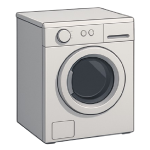
A dryer not heating is one of the most common appliance complaints in 2026 — and while some fixes take less than 20 minutes and cost under $15, others require component-level testing and careful disassembly. This guide ranks the four most likely causes from most to least common so you can diagnose and resolve the problem efficiently without guesswork.
4 Common Causes for a Dryer Not Heating
1Blown Thermal Fuse
The thermal fuse is a one-time safety device mounted directly on the exhaust duct inside the dryer cabinet. When the dryer overheats — typically due to a blocked vent, a failing cycling thermostat, or a restricted lint path — the fuse element melts and permanently opens the heat circuit. Because it fails silently and the drum continues to tumble normally, many homeowners don’t suspect it until they test it. This is the single most common cause of a dryer producing no heat.
Symptoms
- Dryer tumbles and runs a full cycle but produces zero heat — clothes come out damp or cold
- No error codes or warning lights on the control panel; the dryer otherwise behaves normally
Care Plan
- Unplug the dryer and switch off the 240V breaker (electric) or close the gas supply shut-off valve (gas). Put on safety glasses and work gloves before removing any panels.
- Access the thermal fuse. On most dryers, remove the back panel (typically 6–8 screws). The thermal fuse is a small, oblong component — roughly 1–2 inches long — mounted directly on the exhaust duct near the blower housing. Consult your model’s service diagram if you cannot locate it; the model number is on the sticker inside the door opening, on the door frame, or on the back panel.
- Test with a multimeter set to continuity mode. Disconnect both wires from the fuse terminals, then touch one probe to each terminal. A working fuse triggers the continuity beep or a reading near zero ohms; a blown fuse shows OL or silence, indicating an open circuit. Continuity mode alone is sufficient — if you prefer to use resistance (Ω) mode as confirmation, a working fuse reads near zero ohms and a blown fuse reads OL, but either test independently gives you a clear result.
- Replace the fuse if it fails the test. Purchase the exact OEM replacement fuse matching your dryer’s model number — found on the door frame, door opening, or back panel sticker. Thermal fuses are not resettable; a failed fuse must always be replaced, never bypassed. Part cost: $5–$15 at appliance parts retailers.
- Address the root cause before reassembling. A thermal fuse does not blow on its own — something caused the dryer to overheat. Inspect and clean the exhaust vent (see Cause 4) and test the cycling thermostat (see Cause 3) before closing up the cabinet. If a replacement fuse blows again within a few cycles, stop using the dryer and call a professional — this indicates a persistent overheating condition that is a fire hazard.
Common Mistakes
- Bypassing or jumping the fuse. Never install a wire bridge in place of the thermal fuse to “test” whether it was the cause. This removes a critical fire-prevention safety device and can result in a dryer fire.
- Replacing the fuse without clearing the vent. Installing a new fuse into an overheating dryer guarantees the new fuse will blow within a short time. Always diagnose and fix the underlying cause at the same time.
2Failed Heating Element (Electric) or Igniter (Gas)
On electric dryers, the heating element is a coiled resistance wire that generates heat as current passes through it. Over time — typically after years of use — the coil develops a break, cutting the heat circuit entirely while the rest of the dryer continues to operate. On gas dryers, a glow-bar igniter heats to a temperature high enough to ignite the gas that flows into the burner; when the igniter degrades or cracks, it can no longer reach ignition temperature and the burner never lights. Both failures produce the same symptom: the drum spins, the timer advances, but no heat is generated.
Symptoms
- Electric dryer: drum tumbles, but the heating element housing (accessible from the back or front depending on brand) is cold to the touch after a full cycle
- Gas dryer: drum tumbles but you never hear the low “whomp” or rushing sound as the burner flame catches, and there is no warm air at any point in the cycle
Care Plan
- Unplug the dryer (electric) or close the gas shut-off valve and unplug (gas). Confirm gas is off by checking that the valve handle is perpendicular to the gas supply pipe — a parallel handle indicates the valve is open. Verify no gas odor is present before opening the appliance. Wear safety glasses and work gloves.
- Access the heating element or igniter. On most electric dryers, remove the back panel to reach the element housing. On most gas dryers, remove the front panel and lower access panel to reach the burner assembly. Consult your model’s service diagram for exact routing.
- Test the heating element (electric models). Disconnect the element wires and set your multimeter to resistance (Ω) mode. Touch the probes to each terminal. A good residential dryer heating element typically reads approximately 8–30 ohms depending on wattage; consult your model’s service manual for the expected value. A reading of OL or zero ohms indicates a failed element. An open coil is sometimes visible as a gap or burn mark on the element.
- Test the igniter (gas models). Disconnect the igniter wires and measure resistance across the terminals. A functional igniter on most residential gas dryers reads approximately 50–200 ohms; any reading significantly above your model’s specified value — or an OL reading indicating no continuity — warrants replacement. Cross-reference the expected resistance range in your dryer’s service manual, as values vary by manufacturer and wattage.
- Replace the failed component. For electric models, remove the element bracket screws, slide out the old element, and install the OEM replacement for your model number. For gas models, unscrew the igniter bracket, disconnect the igniter plug, install the replacement igniter, and reconnect the plug. Part cost: $20–$80 for most models; OEM parts for premium brands (LG, Bosch, Electrolux) may reach $100–$130. After reassembling a gas dryer, inspect every gas fitting you touched or came near — tighten any that feel loose, then apply a soap-and-water solution to all fittings and connections. Bubbles indicate a gas leak; do not restore gas or run the dryer until the leak is corrected by a licensed technician. If you smell gas at any point after reassembly, vacate the home immediately and call your gas utility from outside.
Common Mistakes
- Accepting a borderline resistance reading without cross-referencing the service manual. The acceptable ohm range varies by model — a reading that falls within a wide general range but above your model’s specified value may indicate a degrading component. Always verify against the manufacturer’s specification.
- Skipping the post-reassembly leak check on gas dryers. Even a seemingly undisturbed fitting can loosen slightly during panel removal or reinstallation. A soap-and-water bubble test takes two minutes and can prevent a serious hazard.
3Faulty Cycling Thermostat
The cycling thermostat is a bimetallic switch that monitors drum air temperature and cycles the heat source on and off to maintain the selected drying temperature. It is typically clipped to or mounted on the exhaust duct outlet just before the blower wheel — more precisely located than simply “near the blower housing.” When the cycling thermostat fails in the open position, it signals the heat circuit to stay off permanently, mimicking the symptom of a blown thermal fuse. Note that most dryer models also include a separate high-limit thermostat mounted nearby on the same duct — this component acts as a secondary cutoff that opens if temperatures exceed a safe threshold. If your cycling thermostat tests good, test the high-limit thermostat next using the same continuity method before moving on to other causes; its failure produces an identical no-heat symptom.
Symptoms
- Dryer tumbles normally but produces little or no heat throughout the entire cycle
- Clothes feel slightly warm at first (residual heat from the motor) but never reach drying temperature
Care Plan
- Safety First: Ensure the dryer is unplugged and the gas is off.
- Locate the Thermostat: The cycling thermostat is typically found on the blower housing or the internal exhaust duct. It is often a small circular or oval component with two to four wires attached. Consult your service manual to distinguish it from the high-limit thermostat.
- Test for Continuity: Set your multimeter to the lowest Ohm (Ω) setting or continuity mode. Disconnect the wires from the thermostat terminals. Touch a probe to each terminal. At room temperature, a functional thermostat should show continuity (near zero ohms or a beep). If the meter reads “OL” (Open Loop), the thermostat has failed in the open position and must be replaced.
- Replace the Component: Unscrew the faulty thermostat and install an exact OEM replacement matched to your model number ($10–$30). Reconnect the wires, ensuring the spade connectors are tight.
- Secondary Check: While the unit is open, test the high-limit thermostat located nearby. It should also show continuity at room temperature. If it is open, replace it as well.
Common Mistakes
- Mixing up the wires. If your thermostat has four wires (common on models with a “bias heater”), the two larger wires are for the heat circuit and the two smaller ones are for the internal heater. Photograph the connections before disconnecting them to ensure they go back on the correct terminals.
- Replacing the thermostat when the vent is the problem. A cycling thermostat often “trips” because air cannot escape. Always perform the vent check in Cause 4 before assuming the part is naturally worn out.
4Blocked or Restricted Exhaust Vent
A dryer relies on high-volume airflow to move moisture out of the drum. If the lint screen is full, or if the flexible foil vent behind the dryer—or the rigid ducting inside your walls—is packed with lint, the hot air cannot escape. The resulting heat buildup will cause the high-limit thermostat or thermal fuse to cut power to the heating element as a fire-prevention measure.
Symptoms
- The dryer runs but clothes are still damp after a full cycle.
- The top or side of the dryer feels unusually hot to the touch.
- You notice a “Flow Sense” or “Check Vent” light on your 2026 digital display.
- There is very little air coming out of the vent flap on the exterior of your house.
Care Plan
- Clear the Lint Screen: This should be done before every load. If the screen is coated in a waxy film from dryer sheets, wash it with hot soapy water and a soft brush.
- Inspect the Transition Duct: Pull the dryer away from the wall and check the flexible hose. Ensure it isn’t crushed or kinked. Vacuum out any lint accumulated at the back of the dryer.
- Clean the Wall Duct: Use a professional dryer vent cleaning brush kit ($20–$30). Attach the brush to a power drill and feed it through the duct from the outside of the house to the inside. Vacuum up the dislodged lint.
- Test Airflow: Reconnect the dryer and run it on a “Timed Dry” cycle. Go outside and feel the exhaust vent. You should feel a strong, warm breeze and the flaps should be fully open.
Common Mistakes
- Using plastic “slinky” vents. These are a fire hazard and are no longer code-compliant in many areas. Use rigid metal or semi-rigid aluminum ducting.
- Assuming the vent is clear because “some” air is coming out. Even a 50% restriction can double your drying time and blow your thermal fuse.