
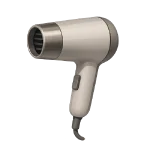
If your hair dryer won’t turn on, the problem is usually located at a safety cutoff, outlet issue, or failed power path rather than a failed motor. Hair dryers commonly interact with both an ALCI plug and a bathroom GFCI outlet, so power can be interrupted in more than one place. This guide ranks solutions from most likely to least likely to help you restore power safely.
5 Common Causes for Hair Dryer Power Loss
1Tripped ALCI Safety Plug
Modern hair dryers feature an ALCI (Appliance Leakage Circuit Interrupter) plug—the large box at the end of the cord. If it detects moisture or an internal electrical fault, it will cut power to prevent injury.
Symptoms
- The unit is completely dead with no lights or sound.
- The small “Reset” button on the plug is popped out or feels loose.
Care Plan
- Plug the dryer into the outlet.
- Press the Reset button (usually red or yellow) firmly until you hear a click.
- If the button pops back out immediately, unplug the dryer; this indicates an active ground fault.
- Try again in a different outlet. If it trips everywhere, the dryer has a dangerous internal short.
Common Mistakes
- Holding the reset button down manually to force the dryer to run. This bypasses a life-saving safety feature and creates a severe shock risk.
2Tripped GFCI Wall Outlet
Most bathrooms are equipped with GFCI (Ground Fault Circuit Interrupter) wall outlets. These outlets trip when they detect current leakage to ground—a sign that electricity is following an unintended path (like through a person or water).
Symptoms
- No power to the dryer, and other items in the same outlet are also dead.
- The “Reset” button on the wall outlet has popped out.
Care Plan
- Unplug the hair dryer.
- Press the Reset button on the wall outlet.
- If the outlet does not reset, check your home’s main breaker panel for a tripped 15A or 20A circuit.
- Warning: If the hair dryer repeatedly trips the GFCI, do not assume the outlet is “too sensitive.” This is a sign of a genuine electrical fault in the unit.
Common Mistakes
- Ignoring repeated trips. If a hair dryer trips a GFCI, it is telling you there is a ground fault. Forcing it to run on a standard outlet in a different room is dangerous.
3Blown Internal Thermal Fuse
If a hair dryer gets too hot (usually due to a clogged filter), a one-time thermal fuse inside the handle or nozzle will blow. This is a physical wire that melts to prevent a fire and cannot be reset.
Symptoms
- The dryer worked fine, got very hot, and then shut off permanently.
- All safety buttons (ALCI and GFCI) are reset, but the unit remains dead.
Care Plan
- Unplug the unit and allow it to cool for 60 minutes.
- Clean the rear intake filter thoroughly to prevent a repeat failure.
- If the unit still won’t turn on, the thermal fuse has likely blown.
- Decision Point: Replacing this fuse involves opening the housing and working near mains-voltage wiring. Unless you are a professional, it is safer to replace the unit.
Common Mistakes
- Bypassing the fuse. Never solder a wire across the fuse contacts. This removes the only fire protection in the device and is extremely hazardous.
4Internal Wire Fatigue (Cord Break)
Hair dryer cords are frequently twisted and pulled. Over time, the copper wires inside the insulation—usually at the handle entry point—can fatigue and snap, leading to electrical arcing.
Symptoms
- The dryer turns on and off as you wiggle or move the cord.
- The cord feels hot to the touch or has a visible kink near the handle.
Care Plan
- Unplug the unit.
- Inspect the cord for cracks, bulges, or signs of melting.
- If a break is confirmed, the unit is a fire hazard.
- Professional Repair Only: Cord repair or replacement must be done by a qualified technician to ensure secure strain-relief and proper insulation.
Common Mistakes
- Using electrical tape to fix a broken internal wire. Tape only masks the outer damage; it does not stop the internal copper arcing, which can ignite the cord.
5Failed Power Switch
The sliding or rocker switch on the handle can fail mechanically or become pitted from electrical arcing, preventing the circuit from closing.
Symptoms
- The switch feels “loose,” “mushy,” or doesn’t click into place.
- You have to hold the switch in a specific position to get the motor to run.
Care Plan
- Unplug the unit.
- If the switch is physically stuck, use compressed air to blow out any hairspray or debris that might be jamming it.
- If the switch moves freely but doesn’t work, the internal metal contacts have likely burnt out.
- In most 2026 consumer models, the switch assembly is not user-serviceable.
Common Mistakes
- Spraying liquid cleaners into the handle. This can gum up the contacts or create a short-circuit hazard once the power is restored.