
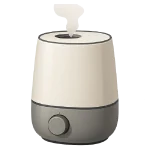
“White dust” is a common byproduct of ultrasonic humidifiers. It is simply the mineral content of your water being aerosolized and settling on your furniture. If you find a fine chalky film on your electronics or tables, follow these 5 fixes to eliminate it.
5 Ways to Stop Humidifier White Dust
1Hard Tap Water Usage
The primary cause is using hard tap water in an ultrasonic humidifier. These units vibrate the water into a mist, taking minerals (calcium, magnesium) with it. When the water evaporates in the air, the solid minerals settle on surfaces.
Care Plan
- Switch to Distilled Water. This is the only 100% effective way to stop white dust.
- If distilled water is unavailable, use Reverse Osmosis (RO) water.
- Note on Softened Water: Ion-exchange softeners replace calcium with sodium. While this reduces white dust significantly, it does not eliminate it entirely and is not a recommended substitute for distilled water.
2Expired Demineralization Cartridge
Many ultrasonic models include a demineralization cartridge to catch minerals before they reach the transducer. If dust reappears, the cartridge resin is likely exhausted.
Care Plan
- Replace the cartridge with a manufacturer-approved part.
- Lifespan Note: While many last 2 months, this varies significantly by water hardness; monitor dust recurrence as your practical indicator for replacement.
- Drop-in “fishes” or universal tablets are available but are generally lower-efficacy options compared to dedicated cartridges.
3Ultrasonic Technology Choice
If buying distilled water is too costly, consider a technology switch. Evaporative humidifiers ($40–$150) use a wick filter that traps minerals internally.
Care Plan
- Switch to an Evaporative humidifier to stop airborne dust entirely.
- Alternatively, use a Steam humidifier (warm mist). These boil the water, leaving minerals behind in the heating chamber.
- Maintenance Note: Steam units require frequent descaling of the heating chamber to prevent internal scale buildup.
4Reverse Osmosis/Filtered Water Gaps
Standard pitcher or fridge filters do not remove the “Total Dissolved Solids” (TDS) that cause dust.
Care Plan
- Use a TDS meter to check your water. Values vary by region (from 50 ppm to over 500 ppm); test your own source rather than assuming a standard range.
- If using an RO System, ensure the membrane is still effective. RO efficiency (usually 90–95%) degrades as membranes age, leading to increased dust.
5Internal Scaling/Lack of Descaling
Accumulated “scale” in the base can be broken down by the transducer and launched into the air.
Care Plan
- Unplug the unit and fill the base with a 1:1 mixture of water and white vinegar.
- Let it soak for 20 minutes to dissolve mineral crust.
- Scrub the base and transducer gently with a soft brush.
- Rinse thoroughly before refilling.