
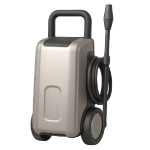
A pressure washer not spraying — engine running, water connected, trigger pulled, and nothing comes out (or only a weak trickle with no usable pressure) — is one of the most common 2026 service calls for this tool. Some fixes take ten minutes and zero tools. Others require pump disassembly. This guide ranks all four causes from most to least likely so you can diagnose and resolve the problem efficiently.
4 Common Causes for a Pressure Washer Not Spraying
1Clogged or Damaged Nozzle
The nozzle orifice — the small precision hole at the tip of the spray wand — is the most common point of blockage. Mineral scale from hard water, dislodged pipe sediment, and fine grit in the water supply all accumulate in this tiny opening and restrict or completely block flow. On quick-connect nozzle sets, the O-ring inside the coupler can also collapse or tear, preventing the nozzle from seating and sealing properly so that pressure escapes around the connection rather than through the orifice.
Symptoms
- Engine runs at normal speed, water is connected and flowing to the machine, but nothing or only a faint dribble exits the wand
- Spray pattern is distorted, streaky, or significantly weaker than usual even though the machine sounds normal
- Nozzle feels loose or rattles slightly in the quick-connect coupler
Care Plan
- Turn off the engine or motor. Point the wand at the ground and squeeze the trigger gun to release all residual pressure. Put on safety glasses before proceeding.
- Remove the nozzle from the quick-connect coupler (rotate the collar and pull outward on most designs).
- Inspect the orifice opening by holding the nozzle up to a light source. If it appears blocked, insert the manufacturer-supplied nozzle cleaning needle — this is the primary tool for this job. If the needle is lost, use a piece of wire that is visibly thinner than the orifice diameter; do not force a wire that fits snugly, as this can deform a brass orifice tip. Clear the blockage with a gentle rotating motion. Do not use a drill bit or any rigid tool with lateral pressure.
- Flush the nozzle by running water backward through it from a garden hose — hold the inlet end (the side that connects to the wand) under the faucet and let water push debris back out the tip.
- Inspect the O-ring inside the quick-connect coupler. If it is cracked, flattened, or missing, replace it with a high-pressure-rated O-ring or a brand-specific seal kit (a brand-specific repair kit costs $10–$20 and uses the correct durometer rating for high-pressure service — generic hardware store assortment packs are often too soft and will extrude at operating pressure). Reinstall the nozzle, start the machine, and test. If the nozzle is physically cracked or the orifice is visibly enlarged, replace the nozzle (typically $5–$15 at any hardware store).
Common Mistakes
- Using a drill bit, nail, or snug-fitting wire to clear the orifice — this permanently enlarges the opening, which has an exponential effect on pressure output and can reduce operating pressure by hundreds of PSI, not a trivial amount.
- Reinstalling the nozzle without flushing the hose and inlet filter first, which immediately re-clogs the freshly cleaned nozzle.
2Kinked, Blocked, or Damaged High-Pressure Hose
The high-pressure hose runs between the pump outlet and the trigger gun. It can fail in several ways: a sharp kink pinches the inner lining and blocks water flow entirely; an internal liner collapse (common in lower-quality hoses after years of use) blocks flow without any visible external damage; and fitting connections at either end can develop leaks where O-rings have failed, causing pressure to bleed out before it reaches the wand.
Symptoms
- Water flows normally when the high-pressure hose is disconnected from the gun, but spray is absent or very weak with it connected
- Visible kink, bulge, abrasion, or cracking along the hose length
- Water leaks at one or both fitting connections when the trigger is pulled
- Hose feels unusually stiff or rigid in one section even when straightened
Care Plan
- Turn off the machine and bleed residual pressure by squeezing the trigger. Put on safety glasses.
- Disconnect the hose at both ends (pump outlet and trigger gun inlet). Lay it out fully straight on the ground.
- Run a garden hose through the disconnected high-pressure hose from one end to the other to confirm water flows freely. If flow is restricted despite the hose being straight, the inner liner has collapsed and the hose must be replaced.
- Inspect both M22 or quick-connect fittings for cracked threads, deformed ferrules, or missing/degraded O-rings. Replace worn O-rings with high-pressure-rated replacements or a brand-specific seal kit ($10–$20) rather than a generic O-ring assortment, which may not be rated for the operating pressure of your machine.
- If the hose is kinked but otherwise undamaged, reconnect it and route it to prevent future kinking — use a hose reel or hanger. If the outer jacket is cracked, abraded through to the braid, or bulging, replace the hose. Do not attempt to re-crimp high-pressure hose fittings — this requires specialized hydraulic crimping tools and exact ferrule specifications. Replace the hose as a complete assembly. A compatible 25- to 50-foot replacement hose costs $20–$60 depending on PSI rating.
Common Mistakes
- Running the machine with the hose sharply coiled or looped around a narrow drum, which accelerates inner liner failure.
- Reusing a hose that has bulged even once — a bulge indicates the wire braid has already partially failed, and the hose is likely to burst under full operating pressure.
3Stuck or Faulty Unloader Valve
The unloader valve is a spring-loaded bypass valve located on or adjacent to the pump head. Its function is critical: when you release the trigger gun, the valve opens and diverts pump output back through an internal bypass circuit, preventing the pump from dead-heading (running against a completely closed system with no flow). Dead-heading causes the trapped water to rapidly overheat, destroying pump seals and O-rings within minutes. When the trigger is pulled again, the valve closes the bypass and redirects flow to the hose and wand.
The unloader valve can fail in two distinct directions. Stuck open (bypass): water continuously loops through the bypass circuit even when the trigger is pulled, so nothing reaches the wand. Stuck closed (no bypass): water cannot bypass when the trigger is released, pressure builds dangerously, the trigger gun becomes very hard or impossible to pull, and hose or pump damage can result. The most common cause of either failure mode is mineral scale from hard water binding the valve piston, or a worn or broken internal spring.
Symptoms
- Engine runs and sounds normal; pump pressurizes (you may hear it load up), but no water exits the wand even with the trigger fully depressed (stuck-open failure)
- Trigger gun is extremely stiff or locked; operating pressure is erratic or surges; hose connections leak under pressure (stuck-closed failure)
- Machine worked normally, was stored for a season, and now produces no spray — mineral scale during storage is a common cause of valve seizure
Care Plan
- Turn off the engine or motor and disconnect the spark plug wire (gas models) or unplug the power cord (electric models). Squeeze the trigger to bleed all residual pressure. Allow the engine and pump housing to cool for at least 10 minutes before touching any components. Put on safety glasses.
- Locate the unloader valve on the pump head. On most consumer machines it is a threaded cartridge assembly, often identifiable by a hex head and a small hose barb (a ribbed nipple fitting where a small rubber bypass hose attaches) or port nearby. Consult your model’s parts diagram if uncertain — the unloader is usually labeled in the pump head exploded view.
- Using the correct-size open-end or adjustable wrench, unscrew the unloader valve cartridge from the pump head. Note the orientation and any thin metal spacers (used to set valve spring pressure) that come out with it — photograph the assembly before disassembly.
- Inspect the valve piston for scale buildup, scoring, or corrosion. Soak a stuck valve in white vinegar for 30 minutes to dissolve light mineral scale — in areas with very hard water or after extended storage, extend the soak to 2–4 hours or repeat as needed, as 30 minutes alone may not fully free a heavily scaled piston. Test that the piston moves freely by pressing it by hand against its internal spring. If the spring is broken, the piston is deeply scored, or the valve remains seized after soaking, the entire unloader cartridge must be replaced.
- Replace the unloader valve. Order an OEM-spec replacement cartridge matched to your pump model number ($15–$50). Apply a thin layer of manufacturer-approved silicone grease to the new O-rings before installation to prevent tearing. Thread the new valve in by hand first to avoid cross-threading, then tighten with a wrench until snug.
- Adjust the pressure (if required). Some unloaders feature a top-mounted adjustment knob. With the machine running and the trigger pulled, turn the knob slowly until you reach the rated operating pressure. Do not exceed the pump’s rated PSI, as this will cause immediate seal failure or engine stall. If spray is still absent after a verified unloader fix, move to Cause 4.
Common Mistakes
- Overtightening the unloader hex head. The pump manifold is often made of relatively soft aluminum or brass; excessive force can strip the internal threads or crack the manifold.
- Testing without water flow. Running the pump dry while testing an unloader will destroy the ceramic plungers and seals within 30 seconds. Always have the garden hose turned on before starting the engine.
4Pump Failure — Check Valves or Plunger Seals
The heart of the pressure washer is the pump manifold, which houses the check valves (one-way valves that direct flow) and the high-pressure seals that surround the ceramic or stainless steel plungers. If the internal check valves are stuck open with debris or if the seals have worn out (often due to being left in “bypass mode” for too long), the pump cannot build pressure, and water will not be forced out through the wand.
Symptoms
- Water flows through the machine at garden-hose pressure only, with no increase when the engine is running.
- Heavy water leaking from the bottom of the pump manifold (indicating seal failure).
- The high-pressure hose vibrates violently or pulsates during use.
- Milky oil in the pump sight glass (indicating water has leaked past the seals into the crankcase).
Care Plan
- Inspect the Check Valves. Unplug the unit or disconnect the spark plug. Unscrew the large hex caps on the pump manifold to access the check valves ($20–$50 for a set). Look for pebbles, grit, or broken springs. Clean or replace the valves and reassemble.
- Inspect the Seals. If the valves are clear but pressure is still low, the high-pressure seals are likely worn. A seal kit typically costs $30–$80. Rebuilding a pump head is a “High” difficulty task that requires a torque wrench and the manufacturer’s specific torque settings.
- Evaluate for Replacement. On many entry-level “axial” pumps (common on budget mowers), the pump is a sealed unit and cannot be repaired. In these cases, a complete replacement pump ($80–$180) is required.
- Professional Service. If the plungers are cracked or the manifold is pitted, the labor and parts cost often exceed the price of a new machine. Consult a professional for a 2026 cost-benefit analysis before proceeding.
Common Mistakes
- Installing check valves backward. These are one-way valves. If you put them in upside down, the pump will not move water at all and may damage the manifold.
- Ignoring milky oil. If your pump oil looks like a latte, stop using the machine immediately. Continuing to run it will destroy the internal bearings, making the pump unrepairable.