
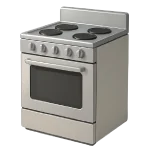
If your Range Not Working issue affects the oven but not the cooktop, the root cause is often a failed heating component or a power problem rather than a full appliance failure. This guide ranks causes from most common to less common to help you diagnose the issue efficiently in 2026.
4 Common Causes for Range Not Working
1Failed Igniter or Heating Element
In gas ranges, the igniter is a high-wear part that eventually burns out or cracks. In electric models, the bake or broil element is a resistive wire that can “pop” or develop a hot spot, breaking the circuit. This is the most common reason for an oven not heating while the stovetop still functions.
Symptoms
- The gas igniter glows (usually orange) but the oven takes >90 seconds to light or never lights (no gas release).
- The electric element shows visible blistering, cracks, or stays cold to the touch.
Care Plan
- For electric ranges, visually inspect the element for any “hot spots” or breaks in the coil.
- For gas ranges, observe the igniter during a preheat cycle; if it glows but the flame does not ignite after 45–90 seconds (or the glow is dim/pale), it is typically too weak to draw sufficient current (≥3.2–3.6 A) to open the gas valve.
- Unplug the range and remove the rear access panel or oven floor to reach the terminals.
- With power off, test resistance (not just continuity) across the terminals with a multimeter set to ohms. Good electric elements read ~19–40 ohms; good gas igniters read ~40–150 ohms (model-specific—check service data). Infinite (‘OL’) means open/failed. For electric bake/broil elements, typical good readings are 19–40 ohms (commonly 20–35 ohms for most 2000–3000W elements at 240V). For gas igniters (glow-bar type), cold resistance is typically 40–150 ohms (often 50–90 ohms); higher values indicate weakness but continuity alone is not sufficient—current draw matters more.
- If the component shows “Open Loop” (OL), replace it with a model-specific OEM part.
Common Mistakes
- Touching a new gas igniter with bare hands; skin oils can cause the element to burn out prematurely.
- Replacing the thermostat when the igniter was actually the failed component.
2Tripped Breaker or Blown House Fuse
Electric ranges typically require a dedicated 40–50 amp, 240V circuit (some newer induction models up to 50–60 A). A power surge or a temporary overload can trip the circuit breaker. In 2026, many homes utilize “Smart Panels” that may disable high-draw appliances during peak demand or if a minor ground fault is detected.
Symptoms
- The display is completely blank and no burners or lights function.
- The range has power to the clock but the oven will not initiate.
Care Plan
- Check your home’s main electrical panel for a tripped double-pole breaker.
- Flip the breaker completely to the OFF position before flipping it back to ON.
- For gas ranges, check the GFI outlet behind the unit; press the “Reset” button if it has popped.
- Verify the power cord is pushed firmly into the 240V wall receptacle.
- If the breaker trips again immediately, stop and call an electrician to check for a short.
Common Mistakes
- Only checking one half of a double-pole breaker; the oven needs both “legs” of 120V to heat.
- Assuming the range is dead without checking if other appliances on the same wall are working.
3Blown Thermal Fuse
The thermal fuse is a safety device designed to “blow” if the oven reaches dangerously high temperatures. This often happens during a “Self-Clean” cycle or if a cooling fan fails. Once blown, it breaks the circuit to the heating elements or the control board.
Symptoms
- The oven stopped working immediately after a self-cleaning cycle.
- The range has power (clock/lights work), but the oven will not heat and/or the door stays locked after a cycle (common after self-clean overheat).
Care Plan
- Disconnect power and pull the range away from the wall to access the back panel.
- Locate the thermal fuse, usually a small white or silver plastic component mounted on the blower housing or back wall. Location varies by model—common spots include near the back wall behind the oven cavity, on the blower housing, near the control board, or on the main back panel. Consult your model’s service manual or tech sheet (often taped inside the console or on the unit) for the exact position.
- With the range unplugged, use a multimeter to check for continuity across the fuse terminals.
- If the multimeter shows no continuity, the fuse has “sacrificed” itself and must be replaced.
- Before restarting, ensure the oven’s cooling fan spins freely and isn’t clogged with dust.
Common Mistakes
- Bypassing the thermal fuse with a jumper wire; this creates a massive fire risk.
- Replacing the fuse without checking why the oven overheated in the first place.
4Faulty Oven Control Board (ERC)
The Oven Control Board (or Electronic Range Control) is the “brain” that sends voltage to the elements and igniters. Over time, the relays on the board can fail, or the solder joints can crack due to the extreme heat generated by the appliance.
Symptoms
- An error code (e.g., F1, F10) appears on the digital display.
- The oven temperature is erratic, overshoots, undershoots significantly, or elements stay on indefinitely.
Care Plan
- Perform a “hard reset” by unplugging the range for 10 minutes to clear the board memory.
- Inspect the board for scorched areas, “puffy” capacitors, or visible burn marks.
- Check the wiring harness for any loose connections or pinched wires leading to the board.
- If the display is functional but doesn’t send power to the elements, the internal relays are likely dead.
- Order a replacement board using the exact model and serial number from the range’s data plate.
Common Mistakes
- Ordering a “universal” board that isn’t compatible with your range’s specific features.
- Failing to use an anti-static wrist strap when handling the new control board.




