
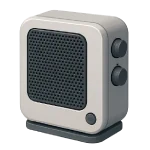
In 2026, space heaters are more “safety-first” than ever. If yours won’t turn on, it’s likely because a sensor thinks there is a danger. Follow these 5 steps to find the break in the power chain.
5 Ways to Fix a Space Heater Not Turning On
1Engaged Tip-Over Safety Switch
Virtually every modern heater has a tip-over switch (usually a physical button on the bottom). If this button isn’t fully pressed in, the heater remains dead to prevent fire.
Symptoms
- The heater works when you lift it but dies when you set it down.
- No lights or fan, even though it’s plugged in.
Care Plan
- Place the heater on a hard, flat surface. Plush carpets can prevent the base button from being fully depressed.
- Inspect the bottom of the heater for the plastic peg. Ensure it isn’t jammed with dust or carpet fibers.
- If using the heater on a rug, place a small wooden board or tile underneath it to provide a firm surface for the switch.
Common Mistakes
- Taping the switch “on” to use the heater on a bed or sofa. This removes your primary protection against a house fire if the unit falls.
2Tripped Internal Thermal Cut-Off
If the heater got too hot during its last use, an internal thermal cut-off may have tripped. This acts like a temporary breaker inside the machine.
Symptoms
- The heater shut off suddenly during use and won’t turn back on.
- The unit feels very hot or was recently covered by a blanket or curtain.
Care Plan
- Unplug the heater immediately.
- Look for a small Reset Button (often on the back or bottom).
- If there is no button, leave the unit unplugged for 20–30 minutes. This allows the bimetallic safety strip to cool and physically “click” back into the on position.
- Note: If the unit remains unresponsive after the full cooling period, a one-time thermal fuse may have blown instead, which requires physical replacement (see Cause 4).
Common Mistakes
- Attempting to turn it back on every 2 minutes. If the strip hasn’t cooled completely, it won’t reset, making you think the unit is permanently broken.
3Tripped AFCI or GFCI Outlet
Homes with modern electrical codes use AFCI (Arc-Fault) or GFCI outlets. Space heaters pull significant current that can trigger these sensitive devices.
Symptoms
- Other devices on the same wall or in the same room are also dead.
- The “Reset” button on your wall outlet has popped out.
Care Plan
- Identify your outlet: A GFCI (Ground Fault) protects against moisture/shocks and is common in kitchens; an AFCI (Arc Fault) protects against sparks and is more common in living spaces. Space heaters are more likely to trip AFCI breakers during normal high-load use.
- Check the outlet for a Reset button and press it firmly.
- Check your home’s main breaker panel for a tripped switch if the outlet won’t reset.
- Move the heater to a different circuit to see if it powers on.
Common Mistakes
- Plugging a 1500W heater into an outlet already powering a high-draw device; the combined amperage will trip the circuit every time.
4Blown One-Time Thermal Fuse
If the heater experienced a severe overheat, a one-time thermal fuse may have blown. Unlike a bimetallic strip, this fuse cannot be reset; it must be replaced.
Symptoms
- The heater is completely unresponsive even after cooling for several hours.
- You recently smelled a brief “hot” odor before it died.
Care Plan
- This requires opening the heater (after unplugging!).
- Use a multimeter to test for continuity across the thermal fuse (usually a small silver cylinder on the wire leading to the element).
- If the fuse is “Open,” it must be replaced with an identical OEM part.
Common Mistakes
- Bypassing the fuse with a wire. This “fix” allows the heater to turn on, but it removes the critical safety feature that prevents the housing from melting and catching fire.
5Frayed Power Cord or Damaged Plug
The heavy power draw of a space heater can degrade the power cord, especially at the “stress point” where it enters the heater or the plug.
Symptoms
- The heater flickers on and off if you wiggle the cord.
- The plug prongs look brown, melted, or feel “squishy.”
Care Plan
- Inspect the entire cord for cracks or melted spots.
- A damaged plug may indicate a loose wall outlet or other power delivery issues.
- If the outlet requires replacement, hire an electrician or, at minimum, use a non-contact voltage tester to verify the power is off before touching any wiring.
- If the cord is frayed, the unit is unsafe and requires a professional cord swap or unit replacement.
Common Mistakes
- Using a standard household extension cord. Most are not rated for the 12.5 Amps a heater pulls, leading to melted plastic and a dead heater.