
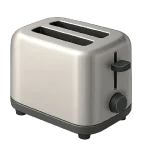
If your Toaster Won’t Stay Down, your breakfast routine comes to a grinding halt. In 2026, most toasters rely on an electronic holding magnet to keep the carriage engaged. When this system fails, the lever simply springs back up immediately. This guide ranks the most likely fixes to get your toaster locking again.
4 Common Causes for Toaster Not Staying Down
1Crumb Buildup in the Latch
The most common reason a toaster won’t lock is that breadcrumbs have fallen into the latching mechanism. These crumbs act as a physical wedge, preventing the metal plate on the carriage from getting close enough to the electromagnet to engage.
Symptoms
- The lever feels spongy or hits a “soft” stop before it clicks.
- Small bits of charred toast fall out when you move the lever.
Care Plan
- Unplug the toaster and remove the crumb tray.
- Hold the toaster upside down over a trash can and shake it gently but thoroughly.
- Use a can of compressed air to blow out the area near the lever track and the bottom latch.
- Check the “catch” at the bottom of the slide for any larger chunks of food.
- Plug it back in and test with the lever.
Common Mistakes
- Shaking the unit over a sink, which can lead to clogged drains over time.
- Forcing the lever down while crumbs are still trapped, which can bend the latch.
2Dirty Electromagnet Contact Plate
The electromagnet relies on a clean, flush connection between a small metal plate and the magnet itself. Over time, kitchen grease or fine dust can coat these surfaces, weakening the magnetic bond until it can no longer hold against the tension of the return spring.
Symptoms
- The toaster stays down for a split second, then pops back up.
- The heating elements begin to glow briefly before the lever releases.
Care Plan
- Unplug the unit and consult the manual for disassembly (methods vary; check for Torx or Phillips screws).
- Locate the small electromagnet near the base of the lever assembly.
- Use a cotton swab lightly dipped in rubbing alcohol to wipe the face of the magnet and its mating metal plate.
- Important: Allow at least 10 minutes for the alcohol to evaporate completely before reassembling.
- Reassemble and test.
Common Mistakes
- Using sandpaper to clean the magnet, which ruins the flat surface required for a strong hold.
- Plugging the unit in while internal components are still damp with alcohol.
3Blown Internal Thermal Fuse
Toasters are equipped with a thermal fuse designed to “blow” and cut power if the unit exceeds safe temperatures. Because the electromagnet requires power to hold the lever down, a blown fuse results in a lever that won’t stay down at all.
Symptoms
- The heating elements never get warm, even for a second.
- The toaster shows no signs of life (no lights on digital models).
Care Plan
- Unplug the toaster and open the side or bottom panel.
- Locate the thermal fuse, usually a small silver cylinder on the main power wire.
- Test for continuity with a multimeter; if there is no continuity, the fuse is blown.
- Replace the fuse with an identical temperature rating printed on the original part (commonly 184°C or 216°C).
- Soldering is the preferred installation method; if using crimp connectors, ensure they are high-quality as they can loosen under repeated heat cycles.
Common Mistakes
- Replacing the fuse based only on amperage/voltage without matching the temperature rating.
- Bypassing the fuse with a wire, removing a critical fire safety feature.
4Damaged Power Cord or Plug
Since the lever is held down by electricity, any break in the power supply will cause it to pop up. A frayed cord or a loose internal wire connection can cause intermittent power loss when the lever is pressed.
Symptoms
- The toaster works if you wiggle the cord.
- Visible fraying or heat damage on the plug or wire.
Care Plan
- Unplug the unit and inspect the entire length of the power cord.
- Look for “kinks” or melted spots near the base of the toaster.
- If the damage is at the plug, install a replacement plug that matches the original grounding configuration (most are 2-prong ungrounded).
- If the damage is inside the toaster, the internal wire leads may need to be re-seated on their terminals.
- Note: Replacing the cord on units under warranty may void your coverage; contact the manufacturer first.
Common Mistakes
- Using a 3-prong plug on a 2-prong cord without proper grounding knowledge.
- Using electrical tape to “fix” exposed wires; tape is not a permanent safety solution.