
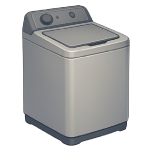
A washer that doesn’t agitate leaves clothes sitting in soapy water and getting nothing clean. In 2026, this remains one of the most common top-load washer complaints — and the good news is that most causes are DIY-friendly. This guide ranks the four most likely culprits from easiest to most complex so you can diagnose and fix the problem without unnecessary guesswork.
4 Common Causes for a Washer That Doesn’t Agitate
1Worn Agitator Dogs
Agitator dogs are small plastic ratchet pawls that lock the upper agitator to the lower agitator barrel during the wash stroke, allowing it to move clothes rather than spin freely. When these pawls wear down — which happens gradually over thousands of wash cycles — the upper agitator loses its grip and rotates in both directions instead of ratcheting in one. This is the single most common cause of a washer that won’t agitate, and it’s also the cheapest fix on this list. Note: Costs vary by region and appliance brand — the figures below reflect average US rates.
Symptoms
- The lower agitator (or the entire post) moves normally, but the upper agitator spins freely in both directions with no resistance
- Clothes come out dirty or barely disturbed after a full wash cycle
Care Plan
- Unplug the washer from the wall outlet before touching any internal components.
- Remove the fabric softener dispenser or cap from the top of the agitator (it typically pulls straight up or twists off), then locate the fastener underneath. Fastener type varies by model — some agitators use a 7/16-inch bolt secured with a socket wrench, others use a spanner nut requiring a spanner wrench, and some older models (particularly GE) simply press onto a splined shaft with no fastener at all. Consult your model’s service sheet or the manufacturer’s parts diagram before assuming which type you have.
- Lift the entire agitator assembly straight up off the drive shaft and set it on a clean surface.
- On dual-action agitators — the most common type and the one most likely to have worn dogs — you must separate the upper barrel from the lower half to access the cam housing (the plastic ratchet assembly inside the top of the agitator barrel). The upper half is typically held by retaining clips around its base; insert a flat-head screwdriver into the seam and gently release each clip before lifting the upper half straight up. Do not pull the upper half forcefully without releasing the clips — doing so can crack the housing and require a full agitator replacement.
- Inside the cam housing you will find the agitator dogs — small wedge-shaped plastic pawls, usually four of them, seated in a circular carrier. Remove the worn dogs and install the new replacement set. Orientation is critical: the angled ratchet teeth on each dog must face the same direction as the originals. Installing them backwards produces the exact same symptom as worn dogs — the agitator will spin freely. Match the tooth direction to a reference photo taken before removal, or to the diagram included with the replacement kit.
- Reassemble in reverse order. Tighten the center fastener firmly — if your model specifies a torque value in its service manual (commonly 16–20 ft-lbs on Whirlpool platforms), use that figure; otherwise tighten until snug without over-torquing the plastic components.
- Run a short wash cycle to confirm the upper agitator now ratchets in one direction only. If it still spins freely, escalate to a professional — the cam housing itself may be cracked or the drive shaft may be worn.
Common Mistakes
- Installing the replacement agitator dogs backwards — the ratchet teeth face a specific direction and must be oriented correctly or the agitator will still spin freely.
- Skipping the clip-release step and forcing the upper agitator barrel off, which cracks the housing and turns a $10 fix into a $60+ agitator replacement.
2Broken or Slipped Drive Belt
Important note before starting: Many modern top-load washers — including most post-1990 Whirlpool and Maytag direct-drive models — do not have a drive belt at all. If you remove the rear or bottom access panel and find no belt present, your washer is a direct-drive model. Skip to Cause 4. Belt-driven machines are most common in older top-loaders and some current Speed Queen and GE models.
On belt-driven washers, a rubber belt connects the motor pulley to the transmission pulley. Over time, heat, friction, and age cause the belt to crack, fray, or snap entirely — leaving the motor running freely with no mechanical connection to the wash drum or agitator. A slipped belt produces the same result even if the belt is physically intact. Costs vary by region and appliance brand.
Symptoms
- The motor hums and runs but the agitator does not move at all
- A burning rubber smell during the wash cycle, or a visible broken belt in the cabinet
Care Plan
- Unplug the washer and turn off both water supply valves. Pull the machine away from the wall far enough to access the rear panel. Tip-forward caution: With the rear panel removed, the machine’s center of gravity shifts. Brace the front of the washer against a wall or have a second person steady it before working — this is especially important on smooth flooring.
- Remove the rear access panel by unscrewing the retaining screws. Some models provide access from the bottom panel instead — check your model’s diagram.
- Locate the drive belt. It runs between the motor pulley (small) and the transmission pulley (large). Inspect it for cracks, glazing (a hardened, shiny surface on the belt caused by heat and slippage — a sign the belt has been slipping before it failed), fraying, or a complete break.
- To remove the old belt, slip it off the motor pulley first — the smaller pulley has the least tension and releases most easily — then off the transmission pulley.
- Check whether your model uses an idler/tensioner pulley before installing the new belt. Many belt-drive washers, including older GE and Speed Queen models, route the belt around a third idler pulley that maintains tension. If your machine has one, the belt must be routed around all three pulleys in the correct sequence — consult your model’s service diagram or parts schematic to confirm the routing path before installation. Installing the belt without the idler pulley will result in immediate slippage or an inability to seat the belt at all.
- Install the new belt by routing it according to your model’s diagram. A common sequence on two-pulley systems is to loop the belt around the larger transmission pulley first, then stretch it onto the motor pulley while slowly rotating the motor pulley by hand — but verify this against your specific model’s service information.
- Confirm the belt seats evenly in the pulley grooves with no twisting, then reinstall the access panel and run a test cycle. If the agitator still fails to move with a properly seated belt, the transmission or motor may be at fault — call a professional.
Common Mistakes
- Assuming all top-load washers have a drive belt — direct-drive models have none, and searching for one wastes time.
- Routing the new belt without checking for an idler pulley, which causes the belt to slip off immediately or prevents proper installation.
3Faulty Lid Switch
The lid switch is a safety interlock that tells the washer’s control system the lid is closed before allowing the motor to run the agitator or spin cycle. On most top-load machines, the wash motor will not receive power if the lid switch fails — even if the lid is physically closed. This makes a failed lid switch easy to misdiagnose as a motor or transmission problem. Costs vary by region and appliance brand.
Symptoms
- The washer fills with water normally but the agitator never starts — and the spin cycle also fails
- You can hear a faint click when closing the lid on a working switch; a failed switch produces no click
Care Plan
- Unplug the washer completely before touching any wiring or internal components — this is a non-negotiable safety step. The lid switch circuit carries line voltage.
- To access the lid switch, you need to open the top panel. On most top-load washers, insert a putty knife approximately 2–3 inches into the seam between the top panel and the front of the cabinet at each front corner — you are pressing inward against the spring clips that hold the panel down, not prying upward on the panel surface. Once both clips release, the top panel tilts back on rear hinges. On some models, the top panel is instead secured by screws at the rear; check your model’s diagram if the clip method yields no result.
- Locate the lid switch assembly — it is typically mounted on the underside of the top panel near the front, with a small plastic plunger that the lid striker tab depresses when the lid closes.
- Disconnect the wiring harness connector from the lid switch. Reminder: the washer must remain unplugged during this and every subsequent step involving wiring contact. Photograph or label the connector orientation before disconnecting so you can restore it correctly.
- Set your multimeter to the continuity or resistance setting. The lid switch is a normally open (NO) switch — this means: with the plunger at rest (not pressed), you should read no continuity (open circuit); with the plunger fully depressed by hand, you should read continuity (closed circuit / near-zero ohms). If you read continuity in both states, or no continuity in either state, the switch has failed and must be replaced.
- Remove the switch from its mounting bracket (usually one or two screws), install the replacement switch, reconnect the wiring harness, lower the top panel until the clips snap back into place, and run a test cycle.
- If the new switch does not resolve the problem, the issue may be in the wiring harness, timer, or control board — escalate to a licensed appliance technician.
Common Mistakes
- Bypassing the lid switch permanently as a workaround — this defeats a critical safety mechanism. A washing machine agitator or drum spinning with the lid open can cause severe hand or arm injuries if reached into, and wet laundry can be ejected forcefully from a spinning drum. Never permanently bypass this switch.
- Misreading the multimeter result by not accounting for the normally-open behavior — a good switch reads open at rest and closed when pressed. Confusing these states will lead to replacing a functional switch.
4Failed Motor Coupler
The motor coupler is found on direct-drive top-load washers — models with no drive belt, most commonly Whirlpool and Maytag machines produced since the late 1980s. It consists of two plastic drive forks and a rubber isolator that sits between the motor shaft and the transmission input shaft (the short shaft protruding from the base of the wash tub assembly). The rubber center is intentionally designed to absorb shock and fail before the motor or transmission do — but after years of heavy loads or a sudden jam, the plastic prongs can snap or the rubber core can strip out. When the coupler fails, the motor will spin freely, but the agitator and the tub will remain motionless.
Symptoms
- You hear the motor running (a steady hum or whir) during the agitation or spin cycle, but nothing inside the tub moves.
- You find small black rubber shavings or broken white plastic bits on the floor directly beneath the center of the washer.
Care Plan
- Unplug the washer and move it away from the wall. Turn off the water valves and disconnect the hoses—be prepared for a small amount of residual water to leak from the hoses.
- Access the motor: Most direct-drive Whirlpool/Maytag models require removing the entire outer cabinet. Pop the plastic end caps off the control console, remove the two hidden screws, and flip the console back. Unplug the lid switch harness, then use a flat-head screwdriver to pop the two large brass-colored clips holding the cabinet to the rear panel. Tilt the cabinet toward you and lift it off the base.
- Remove the pump and motor: The water pump is clipped to the front of the motor; pull the two silver spring clips and move the pump aside (leave the hoses attached). Next, remove the two bolts or clips holding the motor to the transmission. Support the motor as you pull it straight off.
- Inspect the coupler: The coupler consists of two plastic prongs (one on the motor, one on the transmission) and a black rubber “donut” between them. Look for snapped plastic teeth or a rounded-out center in the rubber.
- Replace the assembly: Pry the old plastic hubs off the shafts using a screwdriver. Tap the new hubs onto the shafts using a PVC pipe or a socket that fits over the shaft to avoid cracking the new plastic. Sandwich the rubber isolator between them and bolt the motor back into place. Replacement kits typically cost $10–$25.
- Reassemble and test: Reattach the pump, replace the cabinet, and plug in the lid switch. Run a small test load to confirm the agitator is pulsing correctly.
Common Mistakes
- Hammering the new coupler hubs directly. The plastic is brittle; if you hit it with a hammer, it will crack before you even finish the repair. Use a sacrificial socket or pipe to distribute the pressure.
- Ignoring the “Direct-Drive” distinction. If you buy a belt for a washer that uses a motor coupler, you’ve wasted your afternoon. Check the floor under the washer first—if there are black rubber “shavings” but no belt, it’s almost certainly the coupler.