
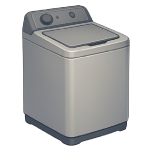
A washer not filling with water is one of the more disruptive laundry room problems you can face — but in 2026, most cases come down to four well-understood causes. While some fixes take under 20 minutes, others require component testing. This guide ranks every cause from most to least likely so you can diagnose and resolve the issue efficiently.
4 Common Causes for a Washer Not Filling with Water
1Faulty Water Inlet Valve
The water inlet valve is an electrically operated solenoid valve that opens when the control board sends a fill signal, allowing hot and cold water to enter the tub. Over time, the solenoid coil inside the valve burns out, or mineral deposits cause the valve’s internal screen or diaphragm to seize in the closed position. When this happens, the valve never opens regardless of what the control board instructs it to do.
Symptoms
- The machine powers on, accepts cycle selections, and begins its cycle timer or countdown — but the drum sits completely idle and silent with no water entering the tub and no agitator or drum movement.
- You can hear an occasional faint humming or clicking from the back of the machine as the control board attempts to signal the valve, but no water follows.
Care Plan
- Unplug the washer and shut off both supply valves. If the outlet is inaccessible, cut power at the circuit breaker before touching anything.
- Pull the washer away from the wall and locate the inlet valve — it sits at the back of the machine where the supply hoses connect. Remove the rear access panel if needed (typically two to four screws).
- Disconnect only the washer end of each supply hose. Leave the wall end connected. Hold the free hose end over a bucket and have a second person nearby or position the bucket securely before opening the wall valve briefly — just 1–2 seconds per hose — to verify strong, unobstructed water flow. If flow is strong, the hoses and household supply are not the problem. Shut the wall valves again before proceeding.
- Disconnect the wiring harness from the inlet valve solenoid terminals. Set your multimeter to the resistance (ohms) mode and touch the probes to the solenoid terminals. A healthy solenoid reads 200–500 ohms. On a digital multimeter, a failed solenoid will display “OL” or “1” on the far left of the screen — this means no continuity and confirms valve failure.
- Remove the two to four mounting screws securing the valve to the machine frame, disconnect the internal water hose, and install the replacement valve in reverse order. If the new valve is installed and the washer still does not fill, the next most likely cause before suspecting the control board is a faulty water level pressure switch — a small component connected to the tub by a rubber hose that tells the board when the tub is full. If it fails in the “full” position, the board never sends the fill signal even to a perfectly functional valve. If replacing the pressure switch also fails to resolve the issue, contact a licensed appliance technician to inspect the control board.
Common Mistakes
- Skipping the multimeter test and replacing the valve on assumption alone — if the pressure switch is the true culprit, a new $25–$65 valve will not fix the problem and you will have spent money and time unnecessarily.
- Installing the replacement valve with the hot and cold ports reversed — check the original valve orientation and your machine’s wiring diagram before final installation.
2Kinked or Clogged Supply Hose
Supply hoses that run behind the washer can kink when the machine is pushed too close to the wall, or the small mesh inlet screens where the hoses connect to the valve can become clogged with sediment and mineral deposits over time. Either condition restricts or completely blocks water flow before it ever reaches the inlet valve. This is one of the easiest and least expensive problems to resolve.
Symptoms
- If the washer takes noticeably longer to fill than it has in the past, or if the cycle stalls or shows a fill error code before reaching the water level sensor threshold, a restricted hose is a likely cause.
- One temperature setting (hot or cold) fills normally while the other fills slowly or not at all — pointing to a blockage in a single hose rather than both.
Care Plan
- Unplug the washer and shut off both supply valves at the wall. If the outlet is inaccessible, cut power at the circuit breaker first.
- Pull the machine out from the wall far enough to visually inspect the full length of both hoses. Look for any sharp bends, kinks, or crimps along the hose body.
- If a kink is found, straighten the hose and reposition the machine so there is at least 4 inches of clearance between the back of the unit and the wall to prevent the hose from bending again.
- Even if no kink is visible, disconnect the hoses from the back of the washer (not from the wall). Have towels or a shallow drain pan ready before disconnecting — residual water will drain from the lines onto the floor. Dry the floor before reconnecting power. Inspect the small mesh screens at the washer inlet ports. Use needle-nose pliers to carefully pull the screens out, then rinse them under running water or soak them briefly in white vinegar to dissolve mineral buildup. Reinstall the clean screens.
- If the screens are damaged or the hose material is cracked, stiff, or blistered, replace both hoses with new braided stainless steel hoses ($10–$30 at any hardware store). Hand-tighten the hose fittings until snug, then use pliers — with a cloth to protect the fitting’s finish — to turn an additional quarter turn. Do not overtighten, as this can crack the rubber washer inside the fitting and cause a slow leak. Restore power and water and run a short cycle to confirm normal fill. If the fill problem persists after cleaning screens and replacing hoses, move on to checking the inlet valve or lid switch.
Common Mistakes
- Reattaching hoses without replacing the rubber washers inside the fittings — old, compressed washers will leak even when properly tightened.
- Pushing the washer back tight against the wall immediately after straightening a kinked hose, re-creating the same kink within the first few cycles.
3Failed Lid or Door Switch
On top-loading washers, a lid switch tells the control board the lid is securely closed before the machine is permitted to fill, agitate, or spin. On front-loaders, a door latch switch and interlock serve the same function. When this switch fails, the control board receives no “closed” confirmation signal and refuses to open the inlet valve — the machine sits in a permanent standby state as a safety measure. This failure is more common on older top-loaders but occurs across all machine types.
Symptoms
- The washer appears to power on and accept cycle selections normally, but the drum never fills, and you hear no water running.
- On top-loaders: pressing the lid down manually during the cycle produces no change in behavior; you may also hear no click from the switch tab engaging.
Care Plan
- Unplug the washer and cut power at the breaker if the outlet is inaccessible. Do not attempt to work on the lid or door switch area with power connected.
- On a top-loader, open the lid and locate the plastic lid switch tab — a small protrusion on the lid that presses into a port on the machine body to activate the switch. Check whether the tab is broken or missing. If broken, a replacement tab alone (often under $5) may resolve the issue.
- If the tab is intact, you need to access the switch body. On most top-loaders, the control panel can be unclipped or unscrewed from the front to allow the top panel to lift up, exposing the switch wiring. On front-loaders, accessing the door latch assembly typically requires removing two to four screws behind the door seal gasket. Work gloves are recommended when accessing door frame components — internal sheet metal edges can have unpainted, sharp burrs that cause cuts.
- Disconnect the switch’s wiring connector and use your multimeter in continuity mode. With the lid or door open, you should have no continuity. Manually press the switch tab in to simulate a closed lid — you should now hear a beep or see a closed-circuit reading. No change in either state confirms a failed switch.
- Remove the faulty switch (typically one to two screws) and install the OEM replacement, reconnecting the wiring harness. Reassemble the panel and test with a short fill cycle. If the machine still does not fill after a confirmed switch replacement, the control board’s input circuit may have failed and a licensed appliance technician should inspect the unit.
Common Mistakes
- Attempting to bypass or permanently tape down the lid switch to force the machine to run. Bypassing this switch defeats a critical safety mechanism. On machines with exposed agitators, entanglement in a spinning agitator with no lid protection can cause serious hand and arm injuries — this failure mode has been the subject of CPSC consumer safety advisories. Bypassing the lid switch may also void your homeowner’s insurance coverage if a resulting injury occurs.
- Ordering a universal switch instead of an OEM or OEM-equivalent part — fit and connector compatibility vary widely by brand and model, and an incorrect switch may not actuate properly even if it physically mounts.
4Insufficient Household Water Pressure
Most washing machines require a minimum of 20 PSI — and ideally 30–100 PSI — to fill reliably. If household pressure drops below this threshold due to a failing pressure regulating valve (PRV), a partially closed main shutoff, or high simultaneous demand from other fixtures, the washer’s fill valve may not open fully or at all. This cause is often overlooked because the home’s faucets and shower may still function at reduced pressure without obvious symptoms.
Symptoms
- All other water fixtures in the home (showers, sinks) have noticeably weaker flow than usual at the same time the washer fails to fill.
- The washer stalls consistently during the fill phase and displays a water supply or fill error code, even with both supply valves fully open.
Care Plan
- Unplug the washer and shut off both supply valves before touching any connections.
- Purchase an inexpensive water pressure gauge ($10–$20 at a hardware store) — it threads directly onto a standard hose bib or laundry room spigot. Turn the supply valve on with the washer disconnected and read the static household pressure (the pressure measured with no water actively flowing through the home).
- A reading below 20 PSI confirms a pressure problem. A reading of 20–30 PSI is marginal and may cause intermittent fill issues. Readings above 100 PSI are dangerously high and can damage appliances and plumbing.
- Check that both hot and cold supply valves behind the washer are fully open — it is common for these to be partially closed after previous service work and forgotten. Also check the main household shutoff valve to confirm it is fully open.
- If pressure is below 20 PSI with all valves fully open, the issue is likely a failing Pressure Regulating Valve (PRV)—the bell-shaped brass valve typically located near your main water shutoff. Adjusting or replacing a PRV should be handled by a licensed plumber ($150–$300), as improper adjustment can lead to burst pipes or damaged appliance solenoids. If your pressure is normal but the washer still won’t fill, the internal Water Level Pressure Switch is the likely culprit; this part tells the washer it’s “full” even when it’s empty.
Common Mistakes
- Mistaking a plumbing issue for an appliance failure. Homeowners often replace a perfectly good inlet valve when the real problem is a clogged sediment screen or a partially closed shutoff valve behind the machine.
- Ignoring the main house shutoff. If you recently had plumbing work done, ensure the main valve was opened all the way; a “half-open” gate valve can provide enough pressure for a sink but not enough to trigger a washer’s high-flow solenoid.