
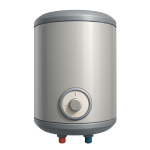
A water heater not heating is one of the most disruptive household failures you can face, especially heading into 2026’s colder months. Some fixes take five minutes; others require component-level diagnosis. This guide ranks the five most common causes from most to least likely so you can resolve the problem efficiently.
5 Common Causes for Water Heater Not Heating
1Tripped Breaker or Blown Fuse
Electric water heaters draw significant amperage — your unit runs on a dedicated double-pole circuit breaker whose amperage is specified on the unit’s data label (commonly 30 amps for standard residential tanks, but your unit may differ — always check the data label or owner’s manual before assuming). A power surge, a momentary overload, or an internal fault can trip that breaker or blow its fuse, cutting all power to the unit. This is the first thing to check because it costs nothing to fix and takes under five minutes.
Symptoms
- Completely cold water at every tap — no warmth at all, even after a full recovery cycle
- The water heater shows no indicator lights, no display activity, and makes no sounds
Care Plan
- Go to your main electrical panel and locate the dedicated double-pole breaker labeled “Water Heater.” If it is in the tripped position (center or opposite of ON), firmly push it fully to OFF and then back to ON.
- Check your unit’s data label to confirm the breaker amperage matches the circuit specification — never install a higher-amperage breaker than the circuit is rated for.
- If your panel uses cartridge fuses instead of breakers, check both fuses with a non-contact voltage tester or a multimeter set to continuity. Replace any blown fuse with an identical amperage replacement.
- Return to the water heater and also check for the high-limit reset button — a small red button located behind the upper access panel, near the upper thermostat. If it has tripped (it will be visibly popped out), press it firmly until you hear a click. This ECO (Energy Cut Off) safety device is one of the most overlooked causes of sudden hot water loss and should be checked every time you investigate a no-heat complaint.
- Allow 60–90 minutes for full tank recovery. If the breaker trips again immediately after resetting, stop and call a licensed electrician — a recurring trip indicates a wiring fault or internal short that cannot be safely self-diagnosed.
Common Mistakes
- Resetting a repeatedly tripping breaker multiple times. Each reset on a faulted circuit can cause additional damage or create a fire hazard — reset once, and if it trips again, call a pro.
- Installing a higher-amperage breaker than the unit requires. Upsizing a breaker does not fix the underlying fault; it removes the protection the breaker is designed to provide.
2Failed Heating Element
Electric water heaters have two heating elements — upper and lower — immersed directly in the tank water. Over time, mineral scale accumulates on the element surface, and dry-fire events (running the element without water, often caused by improper tank refilling after a flush) cause irreversible damage to the resistance wire inside. A failed element will produce either no heat or severely insufficient hot water depending on which one has burned out.
Symptoms
- Upper element failure: only a small amount of lukewarm water before it turns cold
- Lower element failure: water heats slowly and runs out unusually fast; the upper portion of the tank stays warm but volume is inadequate
Care Plan
- Turn off the dedicated circuit breaker at the main panel. Confirm power is off using a non-contact voltage tester at the element terminals before touching any wiring. Ensure the floor around the unit is dry before proceeding.
- Remove the access panel (upper or lower depending on which element you suspect), pull back the insulation, and remove the plastic safety cover to expose the thermostat and element terminals.
- Disconnect the two wires from the element terminals. Set your multimeter to resistance (Ω). Touch one probe to each terminal screw. A functional element will show a finite resistance reading — the exact value depends on the element’s wattage rating (a 4,500W/240V element reads approximately 12.8 Ω; a 3,500W element reads approximately 16.4 Ω; a 5,500W element reads approximately 10.5 Ω — consult your unit’s data label for the correct specification). A reading of zero ohms (dead short) or OL/infinite resistance (open circuit) confirms the element has failed and must be replaced.
- To replace the element: attach a garden hose to the drain valve at the base of the tank and route it to a floor drain or outdoors. For the lower element, drain the tank until the water level is completely below the lower element port — this typically means draining most of the tank. For the upper element, drain only until the water level is confirmed below the upper element port. Attempting to remove either element while water pressure remains above the element port will cause a flood.
- Use an element wrench (available at any hardware store) to unscrew the old element counterclockwise. Install the new element — matching the wattage, voltage, and thread type of the original — with a fresh gasket, torque it snug (do not overtighten), reconnect the wires, and close the cold water supply. Wait until water flows steadily and air-free from an open hot tap (it will sputter at first as air clears the lines — wait for a smooth, continuous stream) before restoring power. If you are uncertain about any step of this process, contact a licensed plumber.
Common Mistakes
- Restoring power before the tank is completely full. Running a heating element without water — even briefly — is a dry-fire event that destroys the element immediately.
- Installing a replacement element with a different wattage than the original without verifying thermostat compatibility. Mismatched wattage can cause nuisance tripping or inadequate heating.
3Faulty Thermostat
Electric water heaters use one or two thermostats (upper and lower) to regulate element cycling. The upper thermostat also contains an integrated high-limit safety cutoff (ECO) that shuts down both elements if the water temperature exceeds a safe threshold — typically around 170°F. A tripped ECO is one of the most common causes of sudden complete hot water loss and is often mistaken for a failed thermostat. A genuinely failed thermostat — one where the internal switch contacts have failed — will produce similar symptoms but requires replacement rather than a simple reset.
Symptoms
- Completely cold water despite the breaker being on and the reset button not visibly tripped
- Water temperature that is erratic — scalding hot one day, lukewarm the next — indicating a thermostat that is cycling incorrectly
Care Plan
- Turn off the breaker and confirm power is off with a non-contact voltage tester at the thermostat terminals before touching any wiring or components.
- Before testing or replacing anything, locate the small red high-limit reset button on the upper thermostat and press it firmly until you hear a click. This ECO reset resolves a large percentage of sudden no-heat calls on its own — allow 60–90 minutes for tank recovery and confirm hot water returns before continuing diagnosis.
- If resetting the ECO does not restore heat, remove the upper access panel, pull back the insulation, and photograph the wiring before disconnecting anything. Water heater thermostats — particularly upper models with integrated ECO switches — have multiple terminals and multiple internal switches. Consult the specific wiring diagram printed on your thermostat or available from the manufacturer before performing continuity testing. Testing between the wrong pair of terminals will produce a false pass or false fail.
- With wires disconnected and the thermostat cold, use a multimeter set to continuity and test across the terminal pairs specified in the wiring diagram. A functioning thermostat (when cold) will show continuity on the heating circuit path. No continuity on the correct terminal pair confirms an open switch — the thermostat has failed and requires replacement.
- Install a direct OEM replacement thermostat (matching the voltage, temperature rating, and wiring configuration of the original). Reconnect the wires in the photographed configuration, replace the insulation and cover, and restore power. If continuity testing is ambiguous or the new thermostat does not resolve the issue, contact a licensed plumber or appliance technician.
Common Mistakes
- Replacing the thermostat without first pressing the ECO reset button. Many thermostats are condemned and discarded when a simple reset would have restored function.
- Testing continuity between random terminal pairs without a wiring diagram. Upper thermostats have four or more terminals — testing the wrong pair will give meaningless results and lead to misdiagnosis.
4Sediment Buildup
In areas with hard water, dissolved calcium and magnesium minerals gradually precipitate out of the water and settle on the tank floor and on the surface of the lower heating element. Over years of use, this layer of scale insulates the element from the surrounding water, forcing it to run hotter and longer to achieve the same heat transfer — eventually causing the element to burn out or the tank to lose meaningful heating capacity. You may notice the problem worsening gradually rather than failing suddenly.
Symptoms
- Rumbling, popping, or crackling sounds during heating cycles — a reliable indicator of water boiling beneath a sediment crust on the tank floor
- Reduced hot water capacity or longer recovery times that have worsened
Care Plan
- Perform a full tank flush. Turn off the power (electric) or set the gas valve to PILOT. Shut off the cold water supply. Attach a garden hose to the drain valve and route it to a safe drainage area.
- Drain and agitate. Open a hot water faucet upstairs to vent the tank. Open the drain valve and allow the tank to empty. Once empty, briefly turn the cold water supply back on in short bursts; this “pulses” the water, stirring up the sediment at the bottom of the tank so it can be carried out through the hose.
- Repeat until clear. Continue flushing until the water exiting the hose is free of sediment and debris.
- Refill correctly. Close the drain valve and remove the hose. Open the cold water supply and keep the hot faucet open until all air is purged and water flows steadily. Restore power or set the gas valve back to ON.
- Install a water softener. If you live in an area with extremely hard water, consider a whole-home water softener to prevent scale from reaching the tank in the first place.
Common Mistakes
- Waiting too long to flush. If sediment is allowed to sit for years, it can “calcify” into a solid, rock-like mass that cannot be flushed out, effectively reducing the tank’s water capacity permanently.
- Forgetting to purge air. Draining the tank introduces air. If you restore power before the air is purged, you will “dry-fire” and destroy the upper heating element instantly.
5Pilot Light or Ignition Failure (Gas Units)
Gas water heaters rely on a pilot light or an electronic igniter to start the burner. If the pilot goes out due to a draft, a faulty thermocouple, or a clogged pilot orifice, the burner will never ignite, and you will have no hot water. On 2026 models with electronic ignition, a failed spark igniter or a faulty gas control valve can cause the same result.
Symptoms
- The burner does not kick on when the thermostat calls for heat.
- On older models, you can see that the pilot flame is not lit through the viewing pane.
- On newer models, the status light on the gas control valve is blinking a specific error code (check the manual or the side of the tank for the code key).
Care Plan
- Check for the smell of gas. If you smell “rotten eggs,” stop immediately, leave the house, and call your utility provider.
- Attempt to relight the pilot. Follow the instructions printed on the side of your water heater. Typically, this involves turning the knob to PILOT, pressing it down, and clicking the igniter button. Once lit, you must hold the knob down for about 60 seconds to allow the thermocouple to heat up.
- Clean the pilot assembly. If the pilot won’t stay lit, the orifice may be clogged with dust. Use a can of compressed air to gently blow out the pilot area.
- Inspect the thermocouple. The thermocouple is a safety probe that tells the gas valve the pilot is lit. If it is bent away from the flame or is covered in soot, the gas valve will shut off for safety. Gently clean it with a piece of fine sandpaper or realign it so it sits in the tip of the flame.
- Replace the thermocouple or gas valve. If the pilot still won’t stay lit after cleaning, the thermocouple has likely failed. If your unit uses electronic ignition and you don’t hear a “clicking” sound when it tries to start, the igniter or the main control valve may need professional replacement.
Common Mistakes
- Forcing the gas knob. If the knob doesn’t turn easily, do not use a wrench; you could snap the internal seals and cause a dangerous gas leak.
- Ignoring the “Status Light.” Modern gas valves are smart. If the light is blinking, it is telling you exactly what is wrong. Don’t start replacing parts until you’ve looked up the blink code.