
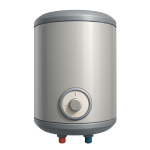
When your water heater water is too hot, the culprit is almost always one of four things: a miscalibrated or stuck thermostat, a shorted heating element that won’t shut off, sediment causing localized superheating, or a cross-connection mixing supply lines. This 2026 guide ranks each cause by likelihood so you can diagnose and fix the problem efficiently — no guesswork required.
4 Common Causes for Water Heater Water Too Hot
1Thermostat Set Too High or Stuck
The thermostat is the primary control that tells the heating element (electric) or gas burner when to stop adding heat. On electric heaters, there are typically two thermostats — upper and lower — each with its own dial. Either one can be accidentally nudged to a higher setting, or the internal contacts can weld shut over time, leaving the element permanently energized. On gas heaters, the thermostat is integrated into the gas control valve (the dial-equipped assembly on the front of the tank that regulates both gas flow and temperature) and can similarly stick in a high-heat position.
Symptoms
- Hot water at the tap is consistently scalding even when set to a moderate dial position
- T&P (temperature and pressure relief) valve drips or discharges periodically
- An instant-read thermometer held under a running hot tap reads well above your dial setting
Care Plan
- Measure actual output temperature first. Run hot water at a tap for two full minutes, then hold an instant-read thermometer (rated to at least 220°F) under the stream. A reading within 5–10°F below your thermostat’s dial setting is normal due to pipe heat loss. A reading significantly above your setting — for example, 145°F when the dial reads 120°F — confirms the thermostat is miscalibrated or stuck.
- Electric heater — adjust the dial. Turn off the water heater at the breaker. Remove the access panel(s) on the side of the tank and peel back the insulation. Use a flathead screwdriver to turn the thermostat dial to 120°F. Replace the insulation and panel, restore power, and recheck the water temperature after one full heat cycle (typically 1–2 hours).
- Gas heater — adjust the dial. Turn the gas control valve dial (the combination valve on the front of the tank) to the 120°F or “B” position. Recheck water temperature after one hour. Do not remove, disassemble, or attempt to replace the gas valve assembly yourself — it involves disconnecting a live gas supply line and must be performed by a licensed plumber or gas technician.
- Electric heater — test the thermostat if adjustment doesn’t resolve it. Turn off the breaker and confirm power is dead at both thermostat terminal screws with a non-contact voltage tester. Disconnect the wires from the thermostat terminals, set your multimeter to continuity or resistance (Ω), and probe across the terminals. A healthy thermostat at room temperature should show continuity (low resistance, typically under 1 ohm) — indicating it is in the “call for heat” position when cold. If it shows continuity after the water has been heated and the unit has reached setpoint, the contacts are welded shut and the thermostat must be replaced.
- Replace a faulty electric thermostat by purchasing an exact-match replacement (match voltage and wattage rating from the old unit’s label). Electric thermostat replacement is a Low difficulty, 15-minute job. For gas heaters, if adjusting the dial has no effect, call a licensed plumber — gas combination valve replacement involves gas line disconnection, costs $80–$250 in parts alone (significantly more than an electric thermostat), and is not a DIY repair.
Common Mistakes
- Adjusting the thermostat without turning off the breaker first (electric). The thermostat terminals on electric water heaters are on a live 240V circuit. Always verify both legs are dead with a non-contact tester before touching any terminal. Note that 240V water heater circuits use double-pole breakers — confirm both poles are off and test both terminal screws, as a mislabeled breaker in an older panel may leave one leg energized.
- Confusing the upper and lower thermostat on electric heaters. Electric water heaters have two thermostats; both must be checked and set to the same temperature. Setting only one and leaving the other at a factory-high setting is a common reason the problem persists after the “fix.”
2Shorted or Continuously Energized Heating Element
Electric water heaters use one or two immersion heating elements that are controlled by the thermostats above them. When an element’s internal resistance wire shorts — either to the other terminal (a dead short producing 0 ohms) or to the element’s outer metal sheath (a ground fault) — it can bypass thermostat control entirely and heat continuously. A continuously energized element will drive water temperature far above the thermostat setpoint and will eventually open the T&P valve. This is one of the more dangerous failure modes because the thermostat cannot stop what it can no longer control.
Symptoms
- Water temperature climbs well above the thermostat setting and does not stabilize
- T&P valve drips or discharges hot water continuously
- The water heater breaker trips (a ground fault will trip a GFCI or overcurrent breaker)
Care Plan
- Turn off the water heater at the breaker. Confirm the breaker is a double-pole type (two adjacent slots in the panel tied together). Flip both poles off, then use a non-contact voltage tester at both element terminal screws to confirm zero voltage on each leg — a 240V circuit has two live conductors, and either can cause electrocution even if the other tests off.
- Remove the access panel and expose the element terminals. Peel back the insulation carefully. Disconnect the two wires from the element’s terminal screws and label them so you can reattach them correctly.
- Test resistance across the two element terminals. Set your multimeter to the resistance (Ω) range. Place one probe on each terminal screw. A functional element will read approximately 10–16 ohms for a standard 4,500W / 240V element; higher-wattage elements read lower (around 8–10 ohms) and lower-wattage elements read higher. A reading of 0 ohms indicates a dead short — the element is failed. A reading of OL (your multimeter will display “OL” or “1.” — meaning no current can pass, i.e., infinite resistance) indicates the wire has burned open. Either condition requires replacement.
- Test for a ground fault (critical — do not skip). Keep one probe on a terminal screw and touch the other probe to the bare metal of the element’s outer sheath or to the tank’s grounded metal body. Any reading other than OL (any continuity at all) indicates a ground fault — the element casing is energized and is a serious shock hazard and a cause of continuous uncontrolled heating. A ground-faulted element must be replaced immediately, regardless of what the terminal-to-terminal resistance read.
- Replace a failed element. Identify whether you are replacing the upper element (located roughly 6–8 inches from the top of the tank) or the lower element (near the tank bottom). Upper element: drain the tank only until the water level drops below the upper access panel — roughly 10–20% of tank capacity. Lower element: the tank must be drained almost completely, as the lower element is near the base; leaving significant water in the tank and removing the lower element will cause a flood or injury. Connect the garden hose to the tank’s drain valve, route it to a floor drain or outdoors, and drain to the appropriate level. Use an element wrench to unscrew the old element (screw-in style) or remove the four mounting bolts (bolt-in flange style). Install the replacement element (match wattage and voltage exactly), tighten securely, close the drain valve, refill the tank completely before restoring power, and open a hot tap to purge all air from the tank before restarting.
Common Mistakes
- Restoring power before the tank is completely refilled. Running a heating element dry — even briefly — will burn it out immediately. Always open a hot water tap and confirm steady (air-bubble-free) flow before turning the breaker back on.
- Skipping the ground-fault test. A terminal-to-terminal resistance reading within the acceptable range does not rule out a ground fault. An element can pass the resistance test and still have its outer sheath energized, which is the failure mode most likely to cause continuous heating and a shock hazard. Always perform both tests.
3Sediment Buildup Causing Localized Superheating
Minerals dissolved in water — primarily calcium and magnesium carbonate — precipitate out as water is repeatedly heated and settle as a hard sediment layer at the bottom of the tank. Over time this layer insulates the tank floor from the bulk water above it. The heating element or gas burner beneath the sediment layer continues to apply heat, but that heat cannot transfer efficiently into the water. The result is localized superheating: the water trapped directly above the sediment layer becomes extremely hot, producing inconsistent temperature spikes at the tap — particularly at the start of a draw, before cooler mid-tank water arrives. The thermostat still cuts off the heat source at its set temperature based on the sensor’s location, but the uneven heat distribution means some water in the tank is far hotter than the sensor reads. The thermostat is not being defeated; the temperature is simply not uniform throughout the tank.
Symptoms
- Water is scalding hot at the start of a draw, then moderates after a few seconds
- Rumbling, popping, or crackling sounds from the tank during heating cycles (steam forming beneath the sediment crust)
- Reduced hot water capacity and longer recovery times than when the unit was new
Care Plan
- Turn off the heat source. Set the gas valve to “Pilot” or flip the electric breaker to “Off.” Allow the tank to cool for at least 2 hours.
- Perform a full tank flush. Attach a garden hose to the drain valve and route it to a floor drain or outdoors. Open a hot water faucet upstairs to act as a vent. Open the drain valve and empty the tank completely.
- Agitate the sediment. With the drain valve still open, turn the cold water supply valve on in short, 10-second bursts. This “pulses” the water, stirring up the heavy sediment at the bottom of the tank so it can be carried out through the hose.
- Repeat until clear. Continue the pulsing process until the water exiting the hose runs crystal clear. If you haven’t flushed your tank in several years, this may take 20–30 minutes of agitation.
- Refill and test. Close the drain valve, remove the hose, and refill the tank completely. Purge all air from the lines by running a hot tap until the sputtering stops. Restore power/gas and check the temperature after the next heating cycle.
Common Mistakes
- Performing a “partial” flush. Simply draining a few gallons won’t remove the heavy, solidified sediment at the bottom. You must empty the tank and use the “pulse” method to stir up the debris.
- Forgetting the cooling period. Draining 140°F+ water through a standard garden hose can cause the hose to soften and kink, or worse, cause the hose to burst and spray scalding water.
4Hot and Cold Supply Cross-Connection
A cross-connection occurs when a failed internal component in a fixture allows hot and cold water to mix where they shouldn’t. While this usually causes the water to be too cold, a failed thermostatic mixing valve (common in 2026 “anti-scald” shower valves and some high-end faucets) can fail in the opposite direction, allowing full-temperature tank water to bypass the safety limit. Additionally, if a single-handle faucet has a failed internal cartridge, it can create a pressure imbalance that forces hot water into the cold lines or vice versa, making the temperature at other taps unpredictable.
Symptoms
- The water is only “too hot” at one specific fixture (e.g., the master shower) while other sinks are normal.
- You notice a change in water temperature at one sink when a different appliance (like the washing machine) starts or stops.
- The water heater thermostat settings are correct and the elements test fine, but the delivered water temperature is erratic.
Care Plan
- Isolate the fixture. Identify if the scalding water is occurring at every tap or just one. If it is localized, the problem is the fixture’s internal cartridge or mixing valve, not the water heater.
- Test the mixing valve. In many 2026 homes, a “master mixing valve” is installed near the water heater to temper the entire house. If the water at every tap is too hot, check this valve first. Adjust the dial on the mixing valve to a lower setting.
- Replace the cartridge. If the issue is localized to a shower or sink, turn off the water to that fixture and replace the internal pressure-balancing or thermostatic cartridge. Over time, mineral buildup can jam these valves in the “Full Hot” position.
- Check the “Recirculation Pump” (if equipped). If your home has a hot water recirculation loop, a failed check valve in the pump assembly can allow water to “backflow,” leading to localized temperature spikes or cross-connections.
Common Mistakes
- Replacing water heater parts for a fixture problem. If the kitchen sink is fine but the shower is scalding, replacing the water heater thermostat will not fix the issue.
- Ignoring a master mixing valve. If your 2026 home has an anti-scald valve at the tank, that valve’s failure is much more likely to cause “too hot” water than a stuck thermostat. Always check the mixing valve before touching the heater’s internal wiring.