
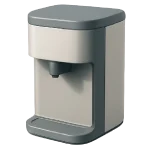
If you find your Water Purifier Not Working, the problem is usually a physical blockage or a pressure imbalance rather than a complex electronic failure. These systems rely on a sequence of pressure-sensitive valves to function. This guide ranks the most common causes to help you restore clean water in 2026.
4 Common Causes for Water Purifier Not Working
1Clogged Filters or Saturated RO Membrane
Water purifiers, especially Reverse Osmosis (RO) systems, rely on three stages of filtration. The “Pre-filters” (Sediment and Carbon) catch large particles to protect the expensive RO membrane. If these aren’t changed every 6–12 months, they become so packed with debris that water cannot pass through to the faucet. Standard replacement intervals in 2026: sediment/carbon pre-filters every 6–12 months (or 6,000–12,000 gallons), RO membrane every 2–5 years depending on feed water TDS/hardness (typically 24–36 months in average municipal water).
Symptoms
- The water flow at the tap is a tiny trickle.
- The system may make a gurgling, hissing, or ‘rattling’ noise from air in lines or pump strain (if present) due to severe restriction.
Care Plan
- Shut off the water supply and the tank valve.
- Use the provided housing wrench to unscrew the vertical filter canisters.
- Replace the Sediment and Carbon filters; ensure the O-rings are lubricated with food-grade silicone grease.
- If the flow is still slow after changing pre-filters, the RO membrane (the horizontal top cylinder) is likely “scaled” with minerals and must be replaced.
- On smart/monitor-equipped models (e.g., Waterdrop G3P800, APEC ROES-PH75 with optional monitor), reset the filter life indicator via app or display after replacement to avoid false low-flow alerts or lockouts.
Common Mistakes
- Installing the filters in the wrong order; the sediment filter must always be the first point of contact for incoming water.
- Forgetting to “flush” the new carbon filters for 5 minutes, which can send black carbon fines into the RO membrane and clog it instantly.
2Low Storage Tank Air Pressure
Most standard under-sink RO systems use a pressurized diaphragm/bladder storage tank (3–4 gallons typical) to store purified water and provide dispensing pressure. As the tank fills with water, it compresses a pocket of air. If that air leaks out over time, there is no “push” to get the water from the tank up to your kitchen faucet.
Symptoms
- The tank feels heavy (full of water), but the faucet only delivers a few seconds of strong flow before dying out.
- The purifier seems to run constantly but never fills the tank.
Care Plan
- Turn off the incoming water supply and open the faucet until it stops dripping.
- Locate the “Schrader valve” (looks like a tire valve) on the side or bottom of the tank.
- Use a pressure gauge to check the air; it should be 7–10 PSI when the tank is empty of water. Exact target varies slightly by manufacturer: 7–8 PSI common for APEC/iSpring, 8–10 PSI for some Home Master/Waterdrop models—always check your model’s manual or label on the tank for the recommended empty pressure (usually 2/3 of incoming feed pressure, but never exceed 10 PSI).
- If low, add air with a bicycle pump (no Schrader valve cap needed); faucet may sputter or spray residual water—normal. Re-check pressure after adding to avoid over-pressurization.
- If water comes out of the air valve itself, the internal bladder has ruptured, and the entire tank must be replaced.
Common Mistakes
- Over-pressurizing above manufacturer spec (typically max 10–12 PSI empty); excess pressure reduces tank capacity and can prevent the RO membrane from filling the tank (feed pressure must overcome tank air pressure).
- Measuring the pressure while the tank is full of water; the reading will be inaccurately high.
3Faulty Auto-Shutoff Valve (ASO) or Check Valve
The Auto-Shutoff Valve (ASO) is the “brain” of a non-electric purifier. It senses the back-pressure from a full tank and shuts off the incoming water line. If this valve or the one-way “Check Valve” fails, the system will either never turn on or, more commonly, never turn off.
Symptoms
- Constant “gurgling” or “hissing” sound coming from the drain line.
- No purified water production (faucet dry) or very slow fill even with good pressure/filters—often from stuck-closed ASO or failed check valve blocking flow.
Care Plan
- To test the ASO, turn on the system and then close the tank valve. Normal behavior: when tank valve is closed (simulating full tank), ASO should shut off feed water within 30–90 seconds and stop drain flow; if drain continues indefinitely, ASO is stuck open or diaphragm failed.
- If the drain water continues to flow indefinitely, the ASO diaphragm is likely torn and the valve must be replaced.
- Inspect the small Check Valve (located in the elbow fitting of the RO membrane housing). If it’s stuck open, it allows tank water to leak back into the drain.
- Ensure the color-coded tubes are pushed firmly into the “Quick Connect” fittings to prevent air from entering the valves.
- Replace these valves every 3–5 years as the internal rubber components lose their elasticity.
Common Mistakes
- Thinking the system is “leaking” because of the drain water; some waste water is normal, but it should not be constant.
- Mixing up the “High Pressure” and “Low Pressure” lines when replacing the ASO.
4Booster Pump or Power Adapter Failure
Many 2026 high-output/efficient RO systems (especially tankless or high GPD models) include an electric booster pump to achieve 60–80+ PSI feed pressure required for optimal rejection and flow. If the pump fails or the power adapter (transformer) burns out, the system cannot generate the pressure required to push water through the RO membrane.
Symptoms
- The system is completely silent (no pump hum) when it should be filling.
- The “Power” or “Pump” LED on the front panel is off or flashing red.
Care Plan
- Check the power outlet with another device to rule out a tripped GFCI.
- Verify that the power adapter is plugged firmly into the pump.
- Test the power adapter output with a multimeter (unloaded and under load if possible); common voltages: 24V DC (many standard), 36V DC (some high-pressure pumps), or 110–240V AC direct to pump—match exact spec from label.
- Inspect the “High-Pressure Switch” (a small sensor on the water line); if this switch is stuck, it tells the pump the tank is “full” even when it’s empty.
- If the pump makes a loud grinding noise or leaks from the “head,” the internal seals have failed and the pump assembly must be replaced.
Common Mistakes
- Replacing the pump when only the $20 power adapter had failed.
- Running the pump dry; if your house water is shut off, always unplug the purifier to prevent pump burnout.