Every property management team knows this: eventually, something in a unit needs attention. The dishwasher starts making a strange noise. The AC works — until the day it doesn’t. A filter needs replacing, but nobody remembers when it was last done.
A Familiar Moment
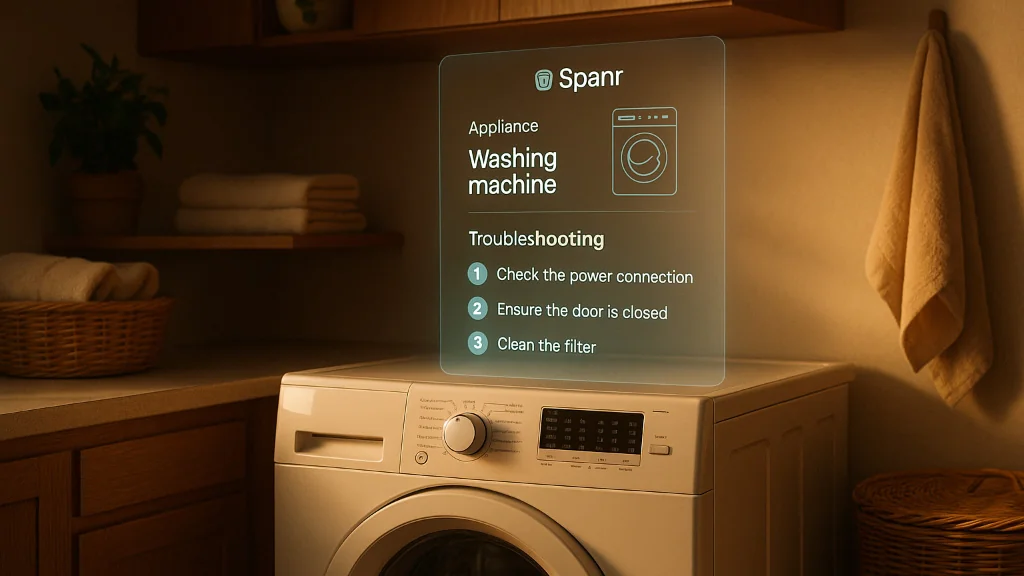
It’s 9 PM on a Tuesday. A resident’s washing machine stops mid-cycle and flashes UE on the display. They need those clothes for tomorrow. They search online, but answers feel vague, conflicting, or written for a technician — not for someone living in the unit. One forum says it’s an unbalanced load. Another suggests the drain pump is failing. A YouTube video walks through a fix — but for a completely different model.
Twenty minutes later, the resident is more confused than when they started — and the next step is often an after-hours maintenance request that didn’t need to happen.
In that moment, the resident wants one thing:
“What does this mean — and what should I do next?”
The Gap: AI Isn’t in Homes — It’s Everywhere Else
Artificial intelligence already helps us plan vacations, write emails, discover recipes, and get medical questions answered. But when something breaks in a unit — whether it’s a noise, leak, smell, or error code — most people still search online, skim outdated forums, watch unrelated repair videos, or submit a service request without knowing whether it’s necessary.
For property management teams, that gap shows up as avoidable work orders, vague requests, and repeat visits. This is the missing use case.
A Quick Reality Check
- Homeowners spend 11.7 hours just researching and scheduling a single repair
- More than 50% of appliance failures are preventable
- Emergency breakdowns cost an average of $1,330
Across a portfolio, those numbers multiply. Yet most units still depend on memory, sticky notes, screenshots, and outdated manuals.
We’re surrounded by smart tech — but real homes still behave like it’s 1998.
Why Homes Are Hard
Homes aren’t standardized. Two identical appliances can behave very differently based on climate, installation, usage, and age.
For example: a refrigerator in humid Florida will frost differently than the same model in dry Arizona. A dishwasher used every day by a family of five will have a different wear pattern than one used twice a week by a couple. The same error code may mean different things depending on these conditions.
Much of what’s needed to maintain or troubleshoot appliances is scattered across receipts, manuals, bookmarked websites, memory — and occasionally a sticky note on the breaker panel.
Put simply:
A home isn’t one device — it’s a living system that evolves, ages, and breaks when ignored.
A Simple Example: What Residents Really Need
Right now, if a dishwasher shows an E24 error, a resident will find dozens of explanations online. They’ll spend time reading forum threads from 2017, watching unrelated videos, and still not know whether they need a $5 fix or a technician.
With Spanr, the experience becomes:
“This means a drain issue. First, check whether the filter is clogged — here’s exactly where it is on your Bosch model.”
Many routine issues go from panic → clarity → problem solved in under 10 minutes — without a work order.
That’s the power of property intelligence.
Where Spanr Fits: Guidance, Not Guesswork
Spanr is the Property Intelligence Platform for residential property managers. It gives property management teams a record of what’s actually inside each unit — appliances, fixtures, and systems — with models, manuals, warranties, and service history.
That intelligence powers Dr. Spanr, the 24/7 home assistant residents receive through their property team. Instead of technical jargon or overwhelming documentation, Dr. Spanr asks simple questions anyone can answer: Is there a noise? Is there a leak? A smell? An error code showing?
Residents don’t need technical knowledge. They describe what they’re experiencing, and Spanr translates symptoms into clear next steps based on the exact model in their unit — whether that’s a filter to clean, a setting to adjust, or confirmation that the issue needs the property team.
Spanr helps avoid unnecessary service calls — and when professional help is needed, the request reaches the property team with the symptoms, photos, asset details, and steps already attempted.
Why This Matters
The impact of unit-specific guidance extends far beyond convenience. When a resident can clear a clogged filter themselves instead of waiting for a $150 service visit, that’s meaningful savings for the property. When the team is alerted to a recall before a safety issue develops, that’s protection. When a warranty expiration is caught before it passes, that’s preserved value for property owners. And when a request does need a technician, the vendor arrives prepared.
These aren’t small wins — across a portfolio, they add up. Over time, Spanr helps property management teams avoid emergency breakdowns, extend asset lifespans through proper maintenance, and make informed repair-or-replace decisions instead of panicked guesses.
Spanr isn’t about adding more smart gadgets to the unit. It’s about giving property teams and residents clarity, control, and peace of mind with the homes they already have.
For too long, residents have been expected to manage complex systems with nothing but scattered manuals and generic online advice — and property teams have absorbed the resulting calls. Spanr changes that equation.
What Residents Really Want
Most residents don’t want to become repair experts. They don’t want complicated technical manuals or hour-long YouTube deep dives. What they want is surprisingly simple: clear meaning, confident direction, and peace of mind.
When something goes wrong at home, the uncertainty is often more stressful than the problem itself. Is this serious? Is it safe? Do I need to call maintenance right now, or can this wait? These questions turn minor issues into urgent requests.
A calm, knowledgeable voice saying, “Here’s what’s happening — and here’s what to do first,” transforms the entire experience. Suddenly, the problem has a name. The next steps are clear. That shift from confusion to clarity is what makes a better resident experience — and a lighter load for the maintenance team.
Good guidance doesn’t just solve problems. It removes uncertainty, restores confidence, and helps residents feel capable in their own homes.
The Future: Property Intelligence in Every Unit
Imagine a portfolio where maintenance feels planned rather than reactive — where water filters are replaced before water quality degrades, where every unit’s HVAC service history is a click away, and where troubleshooting doesn’t mean a resident spending their evening lost in conflicting forum threads.
With property intelligence built around real units, maintenance becomes calmer, clearer, and more predictable:
- No more guessing whether a noise is normal or urgent
- No more binders of manuals nobody can find when they’re needed
- No more late-night calls for issues residents could resolve themselves
- No more paying for service visits that turn out to be simple fixes
Instead, every unit quietly supports the people living in it — and the team managing it.
Ready to Bring Property Intelligence to Your Portfolio?
If your team is tired of vague requests, repeat visits, and after-hours calls for simple fixes — it’s time for a better way.
So the next time an appliance flashes a cryptic error code, your residents will know exactly what to do — and your team will know exactly what happened.
Spanr brings clarity, confidence, and control to property management.